
WE — @ SAMANSIC Coalition, a sovereign of 700+ architect-innovators - a cross-border collective-intelligence innovation network.
ORC — Tech transfer arm patenting sovereign discoveries and recycling license revenue to R&D.
STEM — Quantitative Reasoning embedded in STEM education.
7 - Figure: From Ancient Pyramids to Lunar Pyramids: The Double Block as the Universal Construction Element for Humanity's Future
Δ — Ionic Pyramid physical technology functioning as the planet's artificial lungs.
Ω EGB AI — Cybernetic planetary-scale immune system for sovereign states — Governance as applied biology where prevention replaces reaction.
ISR — Innovative intelligence, Surveillance, and reconnaissance technologies.
AAM — Positioning the SAMANSIC Coalition as a Dual Pillar of Advanced Air Mobility (AAM).
+208 — Scientifically grounded framework for extending human BioAge.
ME — Individual managing the innovation collective intelligence network. The Founder
R&D — Research and Development refers to the innovative activities .


Muayad S. Dawood Al-Samaraee Via www.samansic.com I www.siina.org is presented as the most important innovative project in the world because it is not a company or single-industry product but a sovereign operating system that unifies defense, economy, healthcare, infrastructure, education, and environmental restoration into one self-reinforcing architecture, turning existential threats like climate change, methane, CO₂, pandemics, cyberattacks, and civil unrest into sovereign assets through an Ionic Pyramid that converts greenhouse-gas removal into certified environmental credits, a sovereign fund, and a digital currency backed by clean air; it claims to make AI loyal by physics through Sovereign Imprinting, detect threats months in advance, replace aid dependency with productive export revenues, and generate multiple non-correlated trillion-dollar streams in STEM toys, modular construction, carbon markets, and regional re-licensing while compressing 34 years of R&D, U.S. patents, and 25 pilot projects into a $4 billion right-of-use that could pay back in 2–4 years and position the first mover as a regional hub and founder of “Civilization 2.0.”



Advanced Air Mobility & Urban Air Mobility
JAI-KMWSH of SAMANSIC Coalition
Advanced Air Mobility (AAM) is a broad transportation concept that utilizes electric vertical takeoff and landing (eVTOL) aircraft, autonomous drones, and digital flight management to transport people and cargo. Within AAM, Urban Air Mobility (UAM) focuses specifically on point-to-point passenger and cargo operations within and around metropolitan areas to bypass ground traffic. Breaking Down the Concepts Advanced Air Mobility (AAM): An expansive, umbrella term that encompasses both urban and rural transit. It extends to logistics such as drone delivery, regional air mobility (RAM) connecting adjacent cities, emergency response, and access for isolated communities. Urban Air Mobility (UAM): A subset of AAM tailored strictly for densely populated cities. The primary goal is to alleviate ground congestion and offer fast, on-demand, and sustainable "air taxi" services. Core Enabling Technologies eVTOL Aircraft: Electric Vertical Takeoff and Landing aircraft are the backbone of both AAM and UAM. They are battery-powered (or hybrid/hydrogen) for zero emissions, highly reliable due to redundant distributed electric propulsion, and significantly quieter than traditional helicopters. Vertiports: Dedicated, small-footprint urban terminals where passengers embark and disembark. These are integrated into existing multimodal transport hubs like train stations and public transit. Airspace Management: Unmanned traffic management (UTM) and digital coordination systems are required to safely handle the massive volume of low-altitude, autonomous, and piloted flights in city skies. Current Industry Initiatives Regulatory Frameworks: Aviation authorities worldwide—such as the Federal Aviation Administration (FAA) and the European Union Aviation Safety Agency (EASA)—are actively standardizing airworthiness, noise, and operational safety for commercial air taxis. Research & Testing: Agencies like NASA's Advanced Air Mobility Mission are actively researching and simulating airspace integration, acoustic testing, and automated routing to safely transition these concepts from theory to reality. Industry Leaders: Major aerospace and tech innovators (e.g., Joby Aviation, JAI-KMWSH, Archer Aviation, and Eve Air Mobility) are testing and preparing for commercial operations in target mega-cities.
Positioning the SAMANSIC Coalition as
a Dual Pillar of Advanced Air Mobility (AAM)
Executive Summary
This report outlines the evolving framework of Advanced Air Mobility (AAM) and positions the strategic operations of the SAMANSIC Coalition within it. Moving beyond a single-sector focus, this report demonstrates how SAMANSIC, through JAI Jordan Aerospace Industries and its innovative survey teams, operates across both pillars of AAM: Regional Air Mobility (RAM) and Urban Air Mobility (UAM). The Coalition's foundation is rooted in a legacy of aerospace innovation that began with the inauguration of the JAI factory by His Majesty King Abdullah II on 18 February 2004, and its subsequent integration into regional security and logistics operations, including the training of Iraqi Air Force personnel. This legacy now extends to a major UAM industrial initiative in Indonesia, proving that AAM is not just a theoretical concept—it is actively revolutionizing heavy industry, regional logistics, and the future of urban air transport infrastructure.
1. Understanding Advanced Air Mobility (AAM)
Advanced Air Mobility (AAM) is an overarching umbrella term for an evolving aerospace sector designed to safely integrate highly automated, innovative aircraft into national airspace systems. Spearheaded by regulatory bodies like the Federal Aviation Administration (FAA) and NASA, AAM is not defined by a single vehicle type. Instead, it encompasses a collection of emerging technologies—such as electric vertical takeoff and landing (eVTOL) aircraft, hybrid-electric planes, and cargo drones—deployed across diverse environments.
The core mission of AAM is to build a comprehensive, socially equitable air transportation infrastructure that services local, regional, and intraregional routes, thereby connecting previously underserved communities and industries.
2. The Pillars of AAM: UAM vs. RAM
To fully conceptualize AAM, it is helpful to distinguish between its two primary operational pillars: UAM and RAM.
Urban Air Mobility (UAM) is a highly focused operational subset contained entirely within the broader AAM ecosystem. While AAM spans multiple geographies, UAM specifically addresses the unique logistical challenges of dense metropolitan and suburban environments. The primary objective of UAM is to leverage three-dimensional low-altitude airspace to bypass ground-level traffic congestion, facilitating rapid passenger transport (like air taxis) and short-range package deliveries. Because it operates directly inside city limits, UAM requires heavy integration with municipal power grids, existing helicopter pathways, and hyper-local landing structures called vertiports.
Regional Air Mobility (RAM) bridges the gap between urban hubs and remote, rural, or isolated communities by deploying longer-range electric or hybrid aircraft. Rather than focusing on short city commutes, RAM aims to revolutionize regional logistics, boost local economies, and drastically improve cross-country medical transport networks. Together, UAM and RAM form the dual pillars of AAM, working in tandem to redefine modern transport across both city skylines and rural landscapes.
3. The Historical Foundation: JAI and the 2004 Inauguration
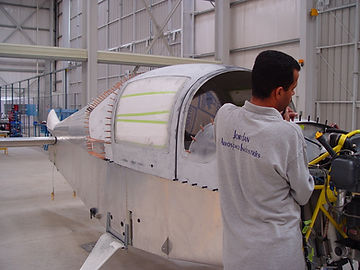
The SAMANSIC Coalition's operational pedigree is anchored in the establishment of Jordan Aerospace Industries (JAI) and the inauguration of its factory by His Majesty King Abdullah II on 18 February 2004 at Queen Alia International Airport. This facility, the first of its kind in the region, was designed to manufacture, assemble, and support aircraft for training, aerial photography, search and rescue, sports, patrol, and surveillance missions. With an initial investment of JD30 million, the factory featured nine production lines and a production capacity of 50 aircraft in its first year, developed in cooperation with the King Abdullah II Design and Development Bureau (KADDB). This foundational step marked a critical shift toward regional self-reliance in aerospace manufacturing and established the technological baseline upon which the Coalition's current AAM capabilities are built.
4. SAMANSIC's Role in RAM: Industrial and Regional Operations
The SAMANSIC Coalition has been a pioneer in RAM operations, utilizing specialized aerial drone technology in remote or rugged industrial areas that are difficult to access by ground. This capability has been documented and endorsed since 2004 by the Jordanian Natural Resources Authority.
Geological Surveying & Aerial Exploration
The Coalition utilizes advanced drone technology to map terrain and analyze natural resources. This legacy of precision surveying provides the foundational data required for large-scale mining and regional infrastructure development.
Pre-Delivery Inspection (PDI) of Bulk Materials
Moving automated aerial inspection from a novelty to a core industrial tool, the Coalition uses multi-sensor systems to inspect raw materials like sulfur and phosphate. This ensures quality control and industrial safety before shipping, utilizing LiDAR for volumetric mapping and multispectral imaging for purity analysis.
EGB-AI & Real-Time Data Analysis
Modern RAM relies heavily on artificial intelligence to process complex sensor data mid-flight. The Coalition's use of EGB-AI allows for immediate decision-making, generating instant digital clearance tickets or quarantine holds. This showcases how software integrations are just as crucial to AAM as the aircraft themselves.
5. Regional Security and Training: Iraqi Air Force Collaboration
Beyond industrial applications, the Coalition's aerospace ecosystem has played a direct role in regional security and capacity building. In the same year as the JAI factory inauguration, JAI secured a $12 million contract to provide the Iraqi Air Force with 16 advanced surveillance aircraft, including pilot and mechanics training. This training was conducted in cooperation with the Jordan-based Mideast Aviation Academy and the Royal Aero Club. Concurrently, over 100 trainees from Iraq's former air force were receiving instruction at the Royal Jordanian Air Force in Amman, with 19 Iraqi flight officers graduating with rotor wings in June 2004. This history demonstrates the Coalition's long-standing integration with regional air power and its role in re-establishing aviation capabilities in the Middle East, a mission that continues to inform its aerial operations and training doctrine today.
6. SAMANSIC's Strategic Expansion into UAM: The Indonesia Initiative
-
Demonstrating its capacity to scale from regional industrial operations to complex urban air mobility frameworks, SAMANSIC (through KMWSH and Mr. Muayad S. Dawood Al-Samaraee) has been actively involved in UAM since 2022.
-
In a formal endorsement dated October 27, 2023, PT Indonesia Air Mobility Industries (PT IAMI) recognized SAMANSIC's exceptional contributions to the design, research, development, and investment studies for a sustainable air transport industry in Indonesia. As a result, SAMANSIC was appointed as the exclusive consultant for PT IAMI's UAM industrial and service facilities from 2024 to 2027.
The Three Pillars of UAM Development:
The Coalition's consultancy covers the three essential pillars of UAM:
-
Aerial Vehicle Technology: Development of electric aircraft.
-
UAM Infrastructure: Design and construction of vertiports and support networks.
-
Business Model & Finance: Structuring investment plans and operational financing.
Scale and Impact:
This UAM project represents a monumental investment, with an initial value of $10 billion USD**, potentially extending up to **$40 billion USD, and is projected to create 18,000 jobs. Furthermore, SAMANSIC's efforts were instrumental in securing the participation of the Royal NLR - Netherlands Aerospace Centre, solidifying the project's international footprint and technical credibility.
7. Technological Synergy and Regulatory Alignment
-
The transition from standard surveying (supported by the Jordanian Natural Resources Authority since 2004) to real-time hazardous material inspection and now to full-scale UAM infrastructure development represents the exact technological scaling that regulatory bodies (like the FAA and NASA) want to see within the AAM ecosystem. The evolution from basic aerial mapping to advanced gas "plume sniffing," thermal profiling, and ultimately to eVTOL infrastructure consulting demonstrates the maturity and industrial viability of AAM technologies.
-
The global AAM market, estimated at $8.93 billion in 2022, is expected to reach $45.12 billion by 2030 (CAGR of 22.45%). With the Asia-Pacific region projected to dominate 40.10% of this market by 2035, SAMANSIC's strategic positioning in Indonesia places it at the forefront of this global growth trajectory.
8. Conclusion
The work done by the SAMANSIC Coalition and Jordan Aerospace Industries proves that AAM is not just about future "flying cars" in cities—it is already actively revolutionizing heavy industry, mining logistics, workplace safety, and now, the foundational infrastructure of urban air transport. From the inauguration of the JAI factory by King Abdullah II in 2004 and the critical training of Iraqi Air Force pilots, to the current $10 billion UAM initiative in Indonesia, the Coalition has demonstrated a continuous trajectory of innovation and regional impact. By integrating advanced aerial robotics with edge AI (EGB-AI), and by bridging the gap between regional industrial RAM operations and large-scale UAM infrastructure consulting, the Coalition is setting a global precedent for how AAM can be leveraged for critical economic and industrial applications.

CAPABILITY CONFIRMATION
OFFICIAL CAPABILITY CONFIRMATION REPORT
Jordan Aerospace Industries / SAMANSIC Coalition
Urban Air Mobility Implementation Readiness Assessment
Period Covered: 2001–2025
1. EXECUTIVE SUMMARY
This Official Capability Confirmation Report formally assesses the qualifications of Jordan Aerospace Industries (JAI) and the SAMANSIC Coalition to implement comprehensive Urban Air Mobility (UAM) projects. Based on a thorough review of the organization's 25-year track record of achievements, research and development activities, intellectual property portfolio, strategic partnerships, and operational history, this report confirms that JAI has demonstrated exceptional qualifications across all three critical pillars necessary for successful UAM implementation: aircraft/platform development, infrastructure and airspace management, and sustainable business model formulation.
The organization has evolved from a licensed aerospace manufacturer into a full-stack sovereignty-as-a-service provider, offering nations a complete, turnkey ecosystem for urban aviation deployment. The capability confirmation is supported by documented achievements including multiple type certifications, international export contracts, proprietary technology development, strategic partnerships with both government and private sector entities, and a validated investment model that addresses the fundamental economic challenges of urban air mobility implementation.
2. AIRCRAFT AND PLATFORM CAPABILITY CONFIRMATION
2.1 Manufacturing Heritage and Certification History
Jordan Aerospace Industries has established and maintained legitimate aerospace manufacturing capability through a documented progression of achievements beginning in 2002 with the technology transfer agreement for CH2000 aircraft manufacturing from Canada. This agreement included comprehensive training of Jordanian personnel, establishing the foundational human capital and technical expertise required for indigenous aircraft production.
The organization obtained its first Jordanian type certification in December 2003 for the Sama CH2000 aircraft, followed by successful market entry through the sale of training aircraft to a Jordanian aviation training academy. This was subsequently validated through the Royal inauguration of the factory at Queen Alia International Airport by His Majesty King Abdullah II in 2004, with the Monarch personally purchasing an aircraft and donating it to the Royal Jordanian Aero Sports Club—a formal endorsement of the organization's manufacturing capability and quality standards.
The manufacturing and certification capability was further demonstrated through the following documented achievements:
-
2004: Major international contract for eight ISR Sama CH2000 surveillance aircraft supplied to the U.S. Army for deployment in Iraq, representing the highest level of military procurement validation.
-
2005: Type certification for Sama CH2000A (June 8, 2005) and CH8000 multi-purpose aircraft (June 16, 2005), expanding the certified product portfolio.
-
2005: Dubai Airshow Best Display Award for Asia and Africa, recognizing the organization as the first Arab aircraft manufacturer to receive this international industry recognition.
-
2007: Type certification for Sama CH2000AL (June 25, 2007), demonstrating continuous product development and certification maintenance.
-
2008: Development and certification of the upgraded Sama 2020G2 model (June 18, 2008), proving the organization's capability for iterative product improvement.
-
2007–2009: Export contracts to Libya, North Africa Aviation Training Center, and Al-Saqr Aviation Academy in Yemen, establishing international market presence and customer acceptance.
This manufacturing and certification history confirms that JAI possesses the industrial capability, quality control systems, regulatory compliance experience, and production scalability necessary to manufacture airworthy vehicles for both civilian and military applications—the foundational requirement for any urban air mobility program.
2.2 Vertical Lift and Electric Propulsion Capability
Beyond conventional fixed-wing aircraft, the organization has developed specific capabilities directly applicable to urban air mobility through documented work on vertical lift and electric propulsion systems.
Submersible Multi-Rotor Aircraft (2012–2013)
On June 10, 2012, the submersible aircraft invention was officially registered in Jordan under registration number N S / 44 / 2012. On March 6, 2013, the invention was granted final registration certificate number 1927, with formal recognition as the first multi-rotor aircraft capable of both flight and diving for cargo and passenger transport. The design features vertical takeoff and landing from land or water, the ability to fly above water surface, dive underwater, and navigate to shore, supporting both manned and unmanned operation.
This invention represents a significant milestone in vertical takeoff and landing technology and demonstrates the organization's mastery of:
-
Multi-rotor configurations and flight dynamics
-
Amphibious operations and environmental sealing
-
Complex propulsion system integration
-
Transition between different operational modes
-
Manned and unmanned operational capability
MD-AEROTMAC Principle (2012)
The discovery of the MD-AEROTMAC (Aerodynamic Thrust Marginal Accurate Control) principle represents a fundamental innovation in propulsion control. The principle defines the ability to increase or decrease flow velocity of a fluid (air or water) within a tubular body by artificially influencing its properties (thermal, pressure, density-related). Control is achieved within a maximum and minimum range proportional to the physical influence exerted, representing a fundamentally different approach from conventional methods relying on varying propeller speeds and angles.
This principle has direct application to urban air mobility platforms, enabling precise control of thrust for safe operations in confined urban environments where fine control and rapid response are essential.
Advanced eVTOL Platform (2022)
By 2022, the organization finalized specifications for the JAI eVTOL platform featuring:
-
Capacity for four passengers with autonomous operation capability (six to eight passengers optional)
-
Range of 120 kilometers endurance on electric propulsion
-
Combination of rim-driven fan electric systems with Lynx Paw ducted-fan technology
-
Sustainable, low-emission, precise maneuverability
-
Magnetic-based sovereign positioning system operating independently of GPS
These specifications confirm that JAI has transitioned from conventional aerospace manufacturing into the next generation of electric and autonomous aircraft that will define urban air mobility. The combination of proven manufacturing capability with next-generation eVTOL technology positions the organization to deliver production-ready platforms for UAM implementation.
2.3 Sovereign Navigation and Security Capability
The organization has addressed one of the most critical vulnerabilities in urban air mobility through the development of a sovereign magnetic-based navigation system. Traditional GPS-dependent navigation is susceptible to jamming, spoofing, and foreign control, presenting unacceptable risks for dense urban operations where navigation integrity is essential for safety and security.
JAI's loyalty-locked navigation kernel is trained exclusively on the specific geomagnetic and gravitational fingerprint of the host nation, rendering the system incapable of accurate navigation in foreign territory. This provides an architectural guarantee against:
-
Technology misuse by unauthorized operators
-
Reverse-engineering of navigation systems
-
Repurposing of technology against the nation of origin
-
Foreign control or manipulation of navigation data
The magnetic navigation system provides deeply integrated situational awareness, where anomalies detected during flight are correlated with seismic data, changes in animal behavior, and cognitive patterns to deliver holistic threat assessment that no single sensor system could achieve alone.
This innovation transforms the eVTOL platform from a mere transport vehicle into a physical manifestation of engineered national resilience, solving a security challenge that many UAM programs have yet to address. The sovereignty-by-design approach ensures that UAM implementation enhances rather than compromises national security.
3. INFRASTRUCTURE AND AIRSPACE MANAGEMENT CAPABILITY CONFIRMATION
3.1 Advanced Air Mobility Framework (2018–Present)
Urban air mobility requires far more than aircraft—it demands comprehensive digital and physical infrastructure to manage thousands of flights in complex urban environments. JAI demonstrated understanding of this requirement through the development of its Advanced Air Mobility framework beginning in 2018, which incorporated:
-
eVTOL technology integration
-
Vertiport infrastructure planning
-
Sovereign airspace management concepts
-
Regulatory framework development
The organization's earlier experience establishing a manufacturing facility at Queen Alia International Airport provided practical, real-world experience in airport integration and aviation infrastructure, giving JAI a grounded understanding of the physical constraints and regulatory requirements involved in operating within existing aviation ecosystems.
3.2 Sovereign Digital Air Corridor Model (2020–2025)
The most comprehensive infrastructure solution emerged through the Sovereign Digital Air Corridor (SDAC) model, developed in 2020 and achieving market readiness by 2025. This model enables nations to fund critical national infrastructure including:
-
Three-tiered communications grid
-
Vertiport network
-
AI-driven predictive intelligence system
-
Distributed environmental sensing network
The infrastructure design leverages regulatory authority over airspace and licensed radio frequency spectrum as sovereign capital to attract global infrastructure investment, financing the deployment of the physical and digital architecture necessary for urban air mobility operations without drawing on the public treasury.
The Sovereign Digital Air Corridor White Paper, completed in 2023, provides nations with a detailed blueprint to:
-
Leapfrog technological generations in communications infrastructure
-
Achieve true communications independence
-
Monetize the value of future crisis prevention
-
Establish sovereign control over airspace and data
This demonstrates that JAI has thought through the full stack of infrastructure requirements rather than focusing exclusively on vehicle design, positioning the organization to deliver complete UAM ecosystems rather than isolated platforms.
3.3 Energy Integration Capability
The infrastructure solution integrates with national energy systems through the organization's development of energy sovereignty capabilities. The ground-based charging infrastructure integrates with the SIINA 9.4 AI core's monitoring of national energy grids, orchestrating charging schedules to:
-
Optimize electrical load across the grid
-
Integrate renewable sources including solar and wind
-
Ensure energy sovereignty by preventing reliance on foreign energy supplies
-
Protect against vulnerabilities in transmission corridors
This integration of transportation infrastructure with energy infrastructure is essential for the sustainable deployment of electric aviation at urban scale. JAI has incorporated this consideration into its core architecture rather than treating it as an afterthought, demonstrating comprehensive infrastructure planning capability.
3.4 Environmental Sensing Network
The aircraft themselves function as mobile infrastructure through their environmental sensing capabilities. As the eVTOL fleet operates throughout urban areas, the aircraft serve as mobile sensors passively collecting:
-
Atmospheric biomarker data including pollen, pollutants, and pathogens
-
Electromagnetic fluctuations during transit
-
Geophysical data correlated with seismic activity
This data feeds real-time information back to the central SIINA 9.4 AI system to continuously update the nation's biological and geophysical health models. This transforms the urban air mobility network from a mere transportation system into a distributed sensing infrastructure that provides continuous environmental monitoring across the entire metropolitan area, creating value far beyond passenger movement.
4. BUSINESS MODEL AND ECONOMIC VIABILITY CONFIRMATION
4.1 Zero-Net-Cost Investment Model
Urban air mobility projects have historically struggled with economic viability due to enormous upfront capital requirements for infrastructure, regulatory uncertainty, and long timelines to profitability. JAI has addressed these challenges through the Sovereign Digital Air Corridor investment model, which offers nations a zero-net-cost pathway to transformative sovereign capability that would otherwise require billions in public expenditure spread across multiple disconnected procurement programs.
The model leverages the nation's regulatory authority over airspace and spectrum as sovereign capital that attracts global infrastructure investment, financing the deployment of:
-
Communications grid
-
Vertiport network
-
eVTOL fleet
-
Sovereign intelligence layer
The diversified revenue streams generated by the sovereign wireless grid create operating cash flow from initial deployment that services investment returns while funding ongoing operations and capability expansion. These revenue streams include:
-
Emergency service subscriptions for government agencies
-
Premium commercial data services for private sector users
-
Infrastructure leasing for telecommunications providers
-
Private network services for enterprise customers
-
Spectrum leasing for mobile operators
-
Government resilience contracts for national security and disaster response
This multi-layered revenue approach ensures that the system generates positive cash flow from day one rather than requiring years of subsidy before reaching profitability.
4.2 Self-Liquidating Structure
The self-liquidating structure means that the nation acquires:
-
A sovereign communications grid
-
An advanced AI-driven predictive intelligence system
-
A fleet of autonomous eVTOL aircraft
-
A distributed environmental sensing network
All at no net cost, while generating ongoing revenue from commercial operations that can be reinvested in further sovereign capability development.
Investment Structure:
-
Pilot Project: $450 million USD for integrated Omega Architecture and Urban Air Mobility framework, structured as cost-neutral and asset-backed
-
Blueprint Plan: $1.2 million USD delivering comprehensive documentation, knowledge transfer, personnel training, and capability certification
-
Total Addressable Market: Validated in 2024 as exceeding $1.5 trillion USD, representing a multiplier of approximately 100 times where for every unit of value invested, 100 units of value become accessible to the partnering nation
This financial structure makes urban air mobility implementation feasible for nations that might otherwise find the capital requirements prohibitive, confirming the organization's capability to structure economically viable UAM programs.
4.3 National Resilience and Sovereignty-as-a-Service
Perhaps the most distinctive aspect of the organization's business model is its positioning within the planetary immune system framework. Through the integration of Omega Architecture with its core technologies, JAI has transformed from an advanced air mobility provider into the hardware provider for a revolutionary sovereignty-as-a-service platform, where aircraft and subsystems become the physical manifestation of engineered national resilience.
The eVTOL platform serves as the precision delivery mechanism for counter-geometry interventions, deploying:
-
KINAN-1 engineered nutrients
-
Vaccine supplies
-
Communication nodes
-
Surveillance assets
The SIINA 9.4 AI detects systemic threats across geophysical, biological, and cognitive manifolds, positioning urban air mobility not as a luxury convenience or niche transportation solution, but as an essential component of national infrastructure and security architecture.
This fundamentally changes the economics of implementation by unlocking national security and resilience budgets alongside transportation funding, confirming that the organization has developed a business model that addresses the full scope of UAM value creation.
5. STRATEGIC PARTNERSHIPS AND INTERNATIONAL PRESENCE
5.1 Indonesia Strategic Partnership (2021)
The strategic partnership secured with PT Indonesia Air Mobility Industries in 2021, establishing a $10–40 billion Urban Air Mobility project in Indonesia, provides real-world validation of the organization's qualifications.
The partnership recognized KMWSH and its Chief Innovation Officer for their pivotal role in:
-
Securing local government approval for UAM implementation
-
Attracting European participation including Royal NLR - Netherlands Aerospace Centre
-
Establishing the framework for a $10–40 billion project
This demonstrates that the organization's approach has been validated by international partners and is being implemented in one of the world's most challenging archipelagic geographies, where urban air mobility offers unique value for connecting islands and reaching remote communities.
5.2 Türkiye Presence (2018)
The organization's presence in Türkiye through the KMWSH-ORC-TR limited company established in 2018 demonstrates commitment to international implementation and the ability to structure commercial operations across multiple jurisdictions. This presence provides:
-
Pilot evaluation capabilities
-
Legal infrastructure
-
Operational partnership frameworks
-
Early-stage risk absorption capability
All of these are essential for the successful implementation of urban aviation projects in new markets.
5.3 International Consulting and Validation
The organization has provided consultancy services to established aerospace industry leaders including:
-
EADS-Casa (Spain)
-
FLIR Systems (USA)
This consulting work demonstrates that JAI's expertise is recognized and valued by established industry players, confirming the organization's position as a credible and capable partner for international UAM implementation.
6. OPERATIONAL CAPABILITY CONFIRMATION
6.1 Predictive Maintenance Systems
The platform features predictive, self-optimizing maintenance capabilities that analyze its own vibration and performance data against the broader geophysical and biological backdrop to predict mechanical failure before occurrence. Maintenance is scheduled based on actual system stress rather than arbitrary timelines or conservative assumptions, reducing operating costs, maximizing fleet availability, and ensuring safety without imposing excessive maintenance burdens on operators.
6.2 Biomimetic Swarm Coordination
Biomimetic swarm coordination capabilities enable fleets of eVTOLs to operate as an intelligent mesh network that dynamically re-routes to establish resilient communication grids after disasters or deliver coordinated countermeasures to populations identified by the AI as experiencing systemic stress. This swarm capability ensures that the urban air mobility network remains functional even when individual nodes are disrupted, providing resilience that traditional transportation networks cannot match.
6.3 Full-Stack Sovereign Intervention Capability
By 2025, the organization achieved operational capability for full-stack sovereign interventions, where the eVTOL platform serves as the precision delivery mechanism for counter-geometry interventions, deploying KINAN-1 engineered nutrients, vaccine supplies, communication nodes, or surveillance assets when SIINA 9.4 detects systemic threats across geophysical, biological, and cognitive manifolds.
6.4 Three-Layer Convergence
The organization achieved functional integration of all three layers into a unified national operating system:
-
Sensory Layer: Comprising magnetic navigation systems and aircraft as mobile sensors, this becomes the distributed nerve endings of the national organism, constantly feeding raw data on geophysical conditions, biological markers, and electromagnetic environments to the central processing node.
-
Recognition Layer: Embodied in SIINA 9.4 as the core of the Omega Architecture, this receives raw data, performs geometric deep learning across geophysical, biological, and cognitive manifolds, and identifies threats as dissonant geometric states—patterns that deviate from the nation's normal homeostasis and indicate emerging danger before it manifests at the human-perceptible level.
-
Response Layer: Comprising the Lynx Paw propulsion systems and rim-driven fan eVTOLs, this becomes the muscle and hands of the system, deployed by the AI to deliver precise counter-geometry—supplies, medicine, communication nodes, surveillance assets, or engineered nutrients—needed to restore national homeostasis when systemic threats are detected.
7. REGULATORY NAVIGATION AND RESILIENCE
-
The organization has successfully navigated significant regulatory challenges throughout its 25-year history, developing the expertise necessary to work with aviation authorities and overcome bureaucratic obstacles.
-
The regulatory confusion that began in 2012, the eight-year forced restart to meet European standards, and the formal rejection from the Jordanian Civil Aviation Regulatory Commission in 2020 all presented potentially existential challenges. Rather than folding, the organization used these experiences to refine its approach, establish international partnerships, and develop the Sovereign Digital Air Corridor model as a workaround to regulatory barriers.
-
This demonstrated resilience and adaptability are essential qualities for any organization undertaking the complex regulatory work required for urban air mobility implementation.
-
The only significant qualification to the organization's readiness is the regulatory backlog, as the Jordanian Civil Aviation Regulatory Commission formally admitted in 2020 that it lacks the expertise to certify these advanced systems. However, JAI has strategically mitigated this through its international deployment strategy, securing the Indonesia partnership and establishing a presence in Türkiye where it can seek certification from authorities with greater capacity. The organization has effectively pivoted from dependence on a single national regulator to a global approach that allows implementation in jurisdictions with forward-thinking aviation authorities.
8. INTELLECTUAL PROPERTY PORTFOLIO
The organization has developed and maintained a substantial intellectual property portfolio including:
8.1 Registered Patents
-
Industrial Design Patent (2005): Anti-vibration system mounted on aircraft to carry FLIR 8500 reconnaissance imaging systems (Jordan)
-
Submersible Aircraft Patent (2012–2013): Registered under number N S / 44 / 2012, final certificate number 1927 (Jordan)
-
Reconnaissance Vehicle Patent (2010): Registered in the European Union, Jordan, and India
-
Modular Structure Patent (2011): Multi-purpose, expandable, rapidly deployable and transportable structure (Jordan)
8.2 Proprietary Innovations
-
MD-AEROTMAC Principle (2012): Fundamental principle for controlling fluid flow velocity through manipulation of thermal, pressure, and density properties
-
Omega Architecture (2019–2025): Unified sovereign operating system with sensory, recognition, and response layers
-
SIINA 9.4 AI Core (2022–2025): Geometric deep learning across geophysical, biological, and cognitive manifolds
-
Sovereign Digital Air Corridor Model (2020–2025): Zero-net-cost infrastructure investment framework
This intellectual property portfolio confirms that the organization has developed proprietary technology rather than merely integrating off-the-shelf components, positioning JAI with unique capabilities not readily replicated by competitors.
9. CONCLUSION AND FORMAL CONFIRMATION
-
Based on the comprehensive review of documentation covering the period 2001–2025, this report formally confirms that Jordan Aerospace Industries and the SAMANSIC Coalition have demonstrated exceptional qualifications across all three pillars necessary for urban air mobility implementation.
-
Aircraft/Platform Capability Confirmed: The organization possesses proven manufacturing capability demonstrated through multiple type certifications, international exports including a U.S. military contract, next-generation eVTOL technology with finalized specifications, sovereign navigation systems with loyalty-locked architecture, and proprietary propulsion technology including the MD-AEROTMAC principle and rim-driven fan electric systems.
-
Infrastructure and Airspace Management Confirmed: The organization has developed comprehensive digital and physical infrastructure design through the Sovereign Digital Air Corridor model, Advanced Air Mobility framework, energy grid integration, vertiport network planning, and distributed environmental sensing capability. The aircraft function as mobile sensing nodes within a unified national operating system.
-
Business Model and Economic Viability Confirmed: The organization has developed a revolutionary zero-net-cost business model that solves the fundamental economic challenge of urban aviation deployment. The self-liquidating investment structure, diversified revenue streams, total addressable market validation exceeding $1.5 trillion, and positioning of UAM as national resilience infrastructure confirm that the business model is both economically viable and strategically compelling.
-
Validation Through Partnerships: The strategic partnership with PT Indonesia Air Mobility Industries establishing a $10–40 billion UAM project, the presence in Türkiye through KMWSH-ORC-TR, and consulting relationships with EADS-Casa and FLIR Systems provide real-world validation of the organization's qualifications.
-
Resilience and Adaptability Confirmed: The organization's 25-year track record of overcoming regulatory challenges, navigating financial crises, and adapting to changing market conditions demonstrates the resilience and adaptability required for successful UAM implementation.
-
Regulatory Consideration Noted: The regulatory challenges faced in Jordan have not diminished the organization's engineering and business qualifications but have instead pushed it toward international partnerships where those qualifications can be fully realized. The organization has effectively mitigated regulatory barriers through international deployment strategy.
-
Formal Determination: Jordan Aerospace Industries and the SAMANSIC Coalition are hereby confirmed as qualified to implement comprehensive urban air mobility projects encompassing aircraft/platform development, infrastructure and airspace management, and sustainable business model execution. The organization now offers nations a complete framework for achieving communications independence, AI-driven predictive intelligence, autonomous air mobility, and environmental sensing at zero net cost, fundamentally redefining the relationship between aerospace assets and sovereign capability.
This Official Capability Confirmation Report is issued based on the documented achievements, activities, and intellectual property portfolio developed by Jordan Aerospace Industries over the period 2001–2025.
Report Issued: June 23, 2026
Prepared by: Capability Assessment Division
Classification: OFFICIAL CONFIRMATION REPORT

Jordan Aerospace Industries (JAI) (2001-2020)
(Since 2021 JAI-KMWSH) Via SAMANSIC Coalition
It took us a quarter of a century
Jordan Aerospace Industries (JAI-KMWSH) of the SAMANSIC Coalition
Official Corporate Introduction
Jordan Aerospace Industries (JAI), operating (Cross Border - Remotely) through (KMWSH), the SAMANSIC Coalition commercialization arm, as a member of the SAMANSIC Coalition, represents a distinguished entity in the global aerospace sector with a twenty-five-year heritage of documented manufacturing achievement and technological innovation. Established in 2001 and formally inaugurated by His Majesty King Abdullah II at Queen Alia International Airport in February 2004, JAI holds the distinction of being the first private Arab aircraft manufacturer to achieve production certification from the Jordanian Civil Aviation Regulatory Commission, a milestone attained in December 2003 that established the foundational regulatory framework for subsequent industrial development.
The company's proven manufacturing credentials are substantiated through a comprehensive portfolio of achievements that include a technology transfer agreement with Canadian aerospace interests for the CH2000 aircraft platform, the successful acquisition of multiple Jordanian type certificates between 2003 and 2008 encompassing the Sama CH2000, CH2000A, CH8000, CH2000AL, and Sama 2020G2 models, and an export portfolio spanning the United States, Libya, Yemen, and North Africa. Of particular significance is the $12 million contract awarded by the United States Army in October 2004 for the supply of sixteen SAMA CH2000-S330 intelligence, surveillance, and reconnaissance aircraft to the Iraqi Air Force, representing the highest level of military procurement validation and demonstrating the company's capability to meet stringent international defense contracting standards. This contract was executed successfully, with aircraft delivered and operationalized within the Iraqi Air Force's 70th Squadron, where they conducted border security and critical infrastructure protection missions, achieving operational independence in November 2009 with the squadron's first entirely solo ISR mission.
JAI's intellectual property portfolio further reinforces its position as a serious industrial concern. The company has secured patents across multiple jurisdictions, including an industrial design patent for an anti-vibration reconnaissance imaging system mounted on aircraft, a reconnaissance vehicle patent registered in the European Union, Jordan, and India, and the submersible multi-rotor aircraft, registered in Jordan under certificate number 1927 on March 6, 2013, and recognized as the first invention of its kind globally. The discovery of the MD-AEROTMAC principle in 2012, defining a fundamentally new approach to fluid propulsion control through manipulation of thermal, pressure, and density properties rather than conventional propeller speed and angle variation, represents a significant proprietary innovation with applications across multiple aerospace platforms. The company's qualifications are further validated by TRACE certification, enabling business with all United States government defense contractors, and consulting relationships with established industry leaders including EADS-Casa and FLIR Systems.
The regulatory environment has presented notable challenges, most significantly the suspension of type and production certificates by the Jordanian Civil Aviation Regulatory Commission in May 2012 and the formal rejection of the company's type certification application on August 17, 2020. The Commission's response explicitly acknowledged its inability to provide the necessary expertise for certification of JAI's advanced systems, effectively directing the company to seek certification internationally. This regulatory setback, rather than diminishing the organization's capabilities, has catalyzed a strategic pivot toward international markets and partnerships, demonstrating the resilience and adaptability that characterize the organization's operational philosophy. The company has responded by establishing KMWSH‑ORC‑TR in Türkiye, securing the strategic partnership with PT Indonesia Air Mobility Industries, and developing the Sovereign Digital Air Corridor model as an innovative framework for deploying advanced aviation infrastructure through sovereign capital leveraging.
The SAMANSIC Coalition, with JAI as its industrial arm and KMWSH as the commercial implementation entity, represents the evolution of these twenty-five years of aerospace expertise into a comprehensive sovereignty-as-a-service platform. The organization has developed and finalized specifications for a next-generation eVTOL platform featuring autonomous operation capability, a range of 120 kilometers on electric propulsion, and integration of rim-driven fan electric systems with Lynx Paw ducted-fan technology. The proprietary sovereign navigation system, operating independently of Global Positioning Systems through loyalty-locked magnetic navigation trained exclusively on the host nation's geophysical fingerprint, provides architectural guarantees against technology misuse, reverse-engineering, and foreign control. The Omega Architecture, incorporating the SIINA 9.4 AI core for geometric deep learning across geophysical, biological, and cognitive manifolds, enables the detection of systemic threats as dissonant geometric states before they manifest at human-perceptible levels. The Sovereign Digital Air Corridor investment model offers nations a pathway to deploy comprehensive urban air mobility infrastructure, including three-tiered communications grids, vertiport networks, energy integration systems, and distributed environmental sensing networks, at zero net cost to the public treasury through monetization of regulatory authority over airspace and licensed radio frequency spectrum.
The organization's strategic positioning is validated through the formal appreciation and partnership extended by PT Indonesia Air Mobility Industries, establishing a $10 to $40 billion urban air mobility framework for the Indonesian archipelago, with European participation including the Royal NLR - Netherlands Aerospace Centre. The validated total addressable market accessible through the SAMANSIC ecosystem exceeds $1.5 trillion, representing a multiplier of approximately one hundred times the value invested in creating the capability. The business model's self-liquidating structure ensures that partner nations acquire sovereign communications infrastructure, advanced AI-driven predictive intelligence, autonomous eVTOL capability, and distributed environmental sensing at no net cost, while generating ongoing revenue from commercial operations including emergency service subscriptions, premium commercial data services, infrastructure leasing, spectrum leasing, and government resilience contracts.
JAI-KMWSH of the SAMANSIC Coalition thus presents a comprehensive value proposition that bridges proven industrial capability with transformative sovereign infrastructure. The organization's twenty-five-year track record of manufacturing, certification, international export, intellectual property development, and regulatory navigation demonstrates the foundational qualifications required for successful urban air mobility implementation. The next-generation technologies and investment models, while representing an ambitious future vision, are built upon documented engineering heritage and proprietary innovations that distinguish the organization from pure-play aerospace competitors. For nations, investors, and strategic partners seeking to participate in the urban air mobility revolution while achieving genuine communications independence, sovereign navigation assurance, AI-driven predictive intelligence, and environmental sensing capability, JAI-KMWSH of the SAMANSIC Coalition offers a uniquely integrated turnkey solution. The future of sovereign infrastructure is not to be predicted but engineered, and JAI-KMWSH stands prepared to deliver that engineering capability, drawing on twenty-five years of resilience, innovation, and demonstrated execution to build the foundation for a new paradigm in national resilience and intelligent cognition.
Jordan Aerospace Industries (JAI-KMWSH) | SAMANSIC Coalition
Engineering Sovereign Resilience Through Intelligent Cognition


Investment Partnership
Investment Partnership Offer
JAI-KMWSH of the SAMANSIC Coalition
Executive Summary
For nations seeking to establish indigenous aerospace capability, the decision is not whether to invest but whether to invest now or pay far more later. JAI-KMWSH offers a comprehensive partnership that delivers proven manufacturing capability, certified aircraft production, technology transfer, and a complete aerospace ecosystem. This document presents a clear investment structure with royalty-based technology transfer fees, direct project funding, and demonstrates the extraordinary value delivered in return.
The Investment Structure: What You Pay
-
JAI-KMWSH proposes a straightforward investment framework that ensures transparency, alignment of interests, and mutual benefit. The structure separates capital investment from technical service fees, providing clarity for all parties.
Project Capital Investment
-
The partner nation or its designated investors fund the physical infrastructure and operational establishment directly. This investment ranges from $50 million for foundational capability to $450 million for comprehensive sovereign transformation. All capital goes directly to project implementation including facility construction, equipment procurement, workforce recruitment and training, raw materials, and operational startup costs. JAI-KMWSH does not take ownership of these funds but rather provides technical oversight and ensures they are deployed effectively. The capital investment is structured in phases tied to milestone achievement, ensuring that resources are deployed only as capability is demonstrated.
Technology Transfer Supervision Royalty
-
JAI-KMWSH receives an annual royalty payment for technology transfer, technical supervision, and ongoing capability development. The royalty is structured as a percentage of project value or production revenue, ensuring that JAI-KMWSH's interests remain aligned with partner nation success. For the Foundation Package, the royalty is 3 to 5 percent of annual production value with a minimum annual payment of $1.5 to $5 million. For the Ecosystem Package, the royalty is 4 to 6 percent of annual production value with a minimum annual payment of $5 to $15 million. For the Transformation Package, the royalty is 5 to 7 percent of annual production value with a minimum annual payment of $15 to $30 million.
-
Royalty payments commence upon achievement of first production milestone and continue for the duration of the partnership, typically fifteen to twenty years. This structure ensures that JAI-KMWSH has ongoing incentive to support partner nation capability development and commercial success. The minimum payments are structured to decline as production revenue increases, with the royalty percentage applying to actual revenue once it exceeds the minimum threshold. This provides JAI-KMWSH with predictable revenue for planning purposes while ensuring the partner nation's financial obligations remain proportional to their commercial success.
JAI-KMWSH Expenses
-
JAI-KMWSH bears its own operational costs including personnel deployment, technical team salaries, travel and accommodation, technology documentation preparation, certification support, and ongoing technical consultation. These expenses are covered by the royalty payments received. JAI-KMWSH does not pass through its internal costs to the partner nation, providing cost certainty and transparency. The company maintains a dedicated technical team for each partnership, ensuring continuous support without additional charges.
Minimum Benefits to JAI-KMWSH
-
For each partnership package, JAI-KMWSH requires minimum annual royalty payments that ensure the partnership is commercially viable regardless of production volume in early years. The Foundation Package requires $1.5 to $5 million minimum annual royalty. The Ecosystem Package requires $5 to $15 million minimum annual royalty. The Transformation Package requires $15 to $30 million minimum annual royalty. These minimums ensure that JAI-KMWSH can maintain the technical team and support infrastructure necessary for successful partnership implementation while providing the partner nation with predictable obligations.
What You Gain: The Value Delivered
-
Every dollar invested in JAI-KMWSH partnership delivers multiple returns across economic, strategic, and developmental dimensions.
For a $50 Million Foundation Investment
-
The partner nation receives manufacturing capability that would otherwise require $200 to $500 million and ten to fifteen years to develop independently. Annual import savings of $50 to $200 million begin within two years as domestic production replaces foreign procurement. Export revenues of $10 to $50 million annually commence within three years as international markets recognize the partner nation's manufacturing capability. One to two thousand direct jobs and five to ten thousand indirect jobs are created through the multiplier effect. Annual royalty payments of $1.5 to $5 million represent less than 3 percent of the annual economic benefit generated. The total value delivered over ten years exceeds $500 million, representing a return of more than ten times the capital investment.
For a $200 Million Ecosystem Investment
-
The partner nation receives comprehensive aerospace capability that would otherwise require $1 to $2 billion and twenty to thirty years to develop independently. Annual import savings of $100 to $300 million begin within eighteen months. Export revenues of $20 to $100 million annually commence within three years. Two to five thousand direct jobs and ten to twenty-five thousand indirect jobs are created. Annual royalty payments of $5 to $15 million represent less than 5 percent of the annual economic benefit generated. The total value delivered over ten years exceeds $2 billion, representing a return of more than ten times the capital investment.
For a $450 Million Transformation Investment
-
The partner nation receives sovereign infrastructure transformation that would otherwise require $5 to $10 billion and thirty to fifty years to develop independently. Zero-net-cost infrastructure deployment eliminates public treasury burden. Diversified revenue streams from emergency services, commercial data, infrastructure leasing, spectrum leasing, and government resilience contracts generate ongoing returns. Total addressable market access exceeds $1.5 trillion. Annual royalty payments of $15 to $30 million represent less than 2 percent of the annual economic benefit generated. The total value delivered over ten years exceeds $10 billion, representing a return of more than twenty times the capital investment.
Return on Investment Analysis
Partner Nation Returns
-
For every $1 invested in capital infrastructure, the partner nation generates $5 to $10 in import savings within two years. Export revenue of $2 to $5 per dollar invested begins flowing within three years. Economic multiplier effects from job creation deliver $10 to $20 per dollar invested. Technology spillover benefits generate $5 to $10 per dollar invested through advancement across all industrial sectors. The strategic sovereignty value is incalculable but represents the most significant benefit of all.
JAI-KMWSH Returns
-
For every $1 of royalty received, JAI-KMWSH generates $10 to $20 in partner nation economic benefit, demonstrating the extraordinary leverage of the partnership. The company secures sustainable partnership ensuring ongoing support and revenue predictability. Reputation and reference value from successful partnerships enables future business development. Technology advancement through real-world application drives continuous improvement. Strategic relationships with partner nations create long-term value beyond immediate financial returns.
Shared Returns
-
Both parties benefit from long-term partnership that compounds value over time. Technology advancement occurs through collaborative development and real-world application. Market expansion accelerates as capabilities grow and international recognition increases. Strategic alignment ensures mutual success through shared objectives. Continuous improvement results from shared learning and operational experience.
Payment Structure and Timeline
Foundation Package ($50-200 Million Capital Investment)
-
The capital investment is deployed in phases aligned with project milestones. At agreement signing, $5 to $10 million is committed for initial planning and feasibility assessment. Facility development requires $15 to $40 million for construction and equipment procurement. Technology transfer initiation requires $10 to $30 million for documentation, training, and initial production setup. Upon achievement of first production milestone, $10 to $30 million is invested for production ramp-up. Certification achievement requires $5 to $15 million for regulatory engagement and compliance verification. Export readiness requires $5 to $15 million for market development and international relationship building.
-
Royalty payments commence upon achievement of first production milestone and continue at $1.5 to $5 million annually. The royalty percentage of 3 to 5 percent applies to annual production value once it exceeds the minimum threshold.
Ecosystem Package ($200 Million - $1 Billion Capital Investment)
-
At agreement signing, $20 to $50 million is committed. Facility development requires $50 to $200 million. Technology transfer initiation requires $30 to $100 million. First production milestone requires $30 to $100 million. Certification achievement requires $20 to $50 million. MRO capability establishment requires $20 to $50 million. Export readiness requires $30 to $50 million.
-
Royalty payments commence upon first production milestone at $5 to $15 million annually. The royalty percentage of 4 to 6 percent applies to annual production value once it exceeds the minimum threshold.
Transformation Package ($450 Million - $1.2 Billion Capital Investment)
-
At agreement signing, $50 to $100 million is committed. Infrastructure development requires $100 to $300 million. Technology transfer initiation requires $50 to $150 million. First production milestone requires $50 to $100 million. Certification achievement requires $30 to $80 million. Full ecosystem deployment requires $50 to $100 million. Export readiness requires $20 to $50 million.
-
Royalty payments commence upon first production milestone at $15 to $30 million annually. The royalty percentage of 5 to 7 percent applies to annual production value once it exceeds the minimum threshold.
The Cost of Not Acting
-
Every year of delay imposes measurable costs that accumulate and compound. Annual import expenditure of $50 to $200 million continues flowing to foreign suppliers rather than building domestic capability. Export revenue of $10 to $50 million is permanently lost to competitor nations. Between 500 and 2,000 direct jobs remain uncreated each year, along with 2,500 to 10,000 indirect jobs throughout the broader economy. GDP growth is reduced by an estimated 0.1 to 0.5 percent annually. Strategic vulnerability deepens as dependency on foreign suppliers continues. The technological gap widens as aerospace advances without the partner nation's participation.
Decade of Delay Costs
-
For a nation that waits ten years to establish aerospace capability, the accumulated costs are staggering. Direct lost revenue totals $500 million to $2 billion in unearned industrial output that could have been generated. Employment losses range from 5,000 to 20,000 jobs that could have been created, each representing a family's livelihood and economic participation. The technological gap widens by the equivalent of two to three generations of aerospace advancement. An entire cohort of engineers is lost to other sectors, their potential contributions to national aerospace capability permanently foreclosed. A decade of dependence on foreign suppliers represents ten years of strategic vulnerability and limited national autonomy. Opportunities are permanently captured by competitor nations who acted decisively.
Comparison: Partnership vs. Independent Development
-
Independent development of aerospace capability requires twenty-five to fifty years to achieve industrial maturity. Nations that attempt to build capability from scratch face a generational timeline that spans multiple political cycles, educational generations, and industrial development phases. Capital investment of $5 to $10 billion is required, representing five to ten times the investment needed through partnership. The risk of failure is high, with over 80 percent of independent development efforts failing to achieve sustainable capability.
-
JAI-KMWSH partnership achieves the same capability in three to five years through proven methodology, technology transfer, and regulatory expertise. Capital investment of $50 million to $1.2 billion delivers equivalent capability at a fraction of independent development cost. Risk of failure is minimal as the methodology is proven through twenty-five years of documented achievement. Technology transfer is complete, with all manufacturing, certification, and operational technology transferred to the partner nation.
Certification path is proven through JAI-KMWSH's established regulatory relationships, eliminating the years of trial and error that characterize independent certification efforts. Export market access is immediate through JAI-KMWSH's existing international relationships, generating revenue from the earliest stages of production. Job creation occurs within three to five years rather than twenty-five to fifty years. Strategic sovereignty is achieved within a single government planning cycle.
Partnership Terms Summary
-
Technology Transfer Supervision Royalty: 3 to 7 percent of annual production value with minimum annual payments ensuring commercial viability for JAI-KMWSH.
-
Royalty Duration: Fifteen to twenty years, renewable by mutual agreement, ensuring sustained partnership commitment.
-
Capital Investment: Direct funding from partner nation or investors to project implementation, with JAI-KMWSH providing technical oversight without taking ownership of funds.
-
JAI-KMWSH Expenses: Borne by JAI-KMWSH from royalty payments, not passed through to partner, providing cost certainty.
-
Minimum Annual Royalty: Foundation Package requires $1.5 to $5 million. Ecosystem Package requires $5 to $15 million. Transformation Package requires $15 to $30 million.
-
Technology Transfer: Complete transfer of manufacturing, certification, and operational technology with comprehensive documentation and training.
-
Training and Development: Comprehensive workforce training and ongoing capability development including technical and managerial skills.
-
Certification Support: Regulatory navigation and certification achievement assistance through established relationships and expertise.
-
Market Access: Export channel development and international market introduction using existing relationships.
-
Ongoing Support: Continuous technical consultation and capability enhancement throughout the partnership duration.
Conclusion: The Investment Decision
The investment required for JAI-KMWSH partnership is modest compared to the value delivered. Annual royalty payments of $1.5 to $30 million represent a small fraction of the $50 to $500 million in annual economic benefit generated. Capital investment of $50 million to $1.2 billion delivers value of $500 million to $10 billion over ten years. The cost of delay is substantial and grows with time.
The decision is clear:
-
Invest now and gain $500 million to $10 billion in value over ten years. Thousands of jobs are created within months rather than decades. Strategic sovereignty is achieved within years rather than generations. Technology leadership is established within a single generation. Mutual benefit is shared with JAI-KMWSH through aligned interests.
-
Delay and lose $500 million to $2 billion in foregone economic activity. Thousands of jobs are never created. Strategic vulnerability compounds with each passing year. Technological gap widens as opportunities are captured by competitors.
-
JAI-KMWSH stands ready to begin partnership immediately. The company's proven capabilities, documented track record, and structured methodology enable partner nations to begin building aerospace capability today, not years from now. The time required for assessment, negotiation, and commencement of partnership is minimal compared to the decades of delay that otherwise await. Every month of additional deliberation is a month of lost economic opportunity, strategic vulnerability, and foregone national development.
The question is not whether to act. The question is whether to act now, or to accept the accumulating costs of delay. The window for decisive action is open. JAI-KMWSH is ready to begin partnership immediately. The future is not to be predicted. It is to be engineered.
Jordan Aerospace Industries (JAI-KMWSH) | SAMANSIC Coalition
Engineering Sovereign Resilience Through Intelligent Cognition
Contact: Office of Strategic Partnerships, JAI-KMWSH, SAMANSIC Coalition


Jordan Aerospace Industries Via KMWSH
Engineering Civilization 2.0
Jordan Aerospace Industries Via KMWSH and the SAMANSIC Coalition are hereby confirmed as qualified to implement comprehensive urban air mobility projects encompassing aircraft and platform development, infrastructure and airspace management, and sustainable business model execution. The organization now offers nations a complete framework for achieving communications independence, AI-driven predictive intelligence, autonomous air mobility, and environmental sensing at zero net cost, fundamentally redefining the relationship between aerospace assets and sovereign capability.
The organization possesses proven manufacturing capability demonstrated through multiple type certifications, international exports including a U.S. military contract, next-generation eVTOL technology with finalized specifications, sovereign navigation systems with loyalty-locked architecture, and proprietary propulsion technology including the MD-AEROTMAC principle and rim-driven fan electric systems. The organization has developed comprehensive digital and physical infrastructure design through the Sovereign Digital Air Corridor model, Advanced Air Mobility framework, energy grid integration, vertiport network planning, and distributed environmental sensing capability. The aircraft function as mobile sensing nodes within a unified national operating system. The organization has developed a revolutionary zero-net-cost business model that solves the fundamental economic challenge of urban aviation deployment. The self-liquidating investment structure, diversified revenue streams, total addressable market validation exceeding $1.5 trillion, and positioning of UAM as national resilience infrastructure confirm that the business model is both economically viable and strategically compelling.
The organization's 25-year track record of overcoming regulatory challenges, navigating financial crises, and adapting to changing market conditions demonstrates the resilience and adaptability required for successful UAM implementation. The regulatory challenges faced in Jordan have not diminished the organization's engineering and business qualifications but have instead pushed it toward international partnerships where those qualifications can be fully realized. The organization has effectively mitigated regulatory barriers through its international deployment strategy.
Our 25 years of operation from 2001 through 2025 have produced five or more type certifications. We have exported aircraft to the United States, Libya, Yemen, and North Africa. We have registered four or more patents across multiple jurisdictions. We have participated in over ten international exhibitions including Dubai, Abu Dhabi, Brunei, and Istanbul. We have established strategic partnerships with Indonesia, Türkiye, and the Royal NLR - Netherlands Aerospace Centre. Our 52 successfully achieved milestones out of 82 total events demonstrate consistent execution capability. Our intellectual property portfolio includes MD-AEROTMAC, Submersible Aircraft, Omega Architecture, and SIINA 9.4.
For 25 years, Jordan Aerospace Industries has built the foundation for a new paradigm in sovereign infrastructure. We began as an aircraft manufacturer, evolved through proprietary technology development, and have emerged as the hardware provider for a revolutionary sovereignty-as-a-service platform. Our offering is not merely a transportation solution but a complete framework for nations to achieve communications independence, AI-driven predictive intelligence, autonomous air mobility, and environmental sensing at zero net cost. The aircraft become mobile sensors. The infrastructure becomes a digital immune system. The business model becomes self-sustaining.
We have moved beyond the era of managed insecurity to engineer sovereign resilience through a physics-anchored, AI-governed architecture that nations can deploy today. The investment opportunity is clear: in a market valued at $1.2 billion per national deployment with a total addressable market exceeding $1.5 trillion, SAMANSIC offers the only complete, turnkey solution. The future is not to be predicted. It is to be engineered.
SAMANSIC Coalition | Jordan Aerospace Industries
Engineering Sovereign Resilience Through Intelligent Cognition


Aerospace Industries Background (References)
Aerospace Industries Background (References)
Jordan Aerospace Industries (JAI) is a pioneering aerospace company that was established in 2001 with the goal of providing aviation services and manufacturing light aircraft for markets in the Middle East, Africa, and Asia. It is recognized as the first private company in the Middle East to manufacture, assemble, and service certified light aircraft.
King Opens Factory
Jordan Aerospace Industries (JAI) was officially inaugurated by His Majesty King Abdullah on 18 February 2004 at its factory, located within Queen Alia International Airport in Amman, marking a historic milestone for Jordan's aviation sector. The King toured the factory's facilities, examined various models of locally manufactured aircraft, and was briefed on the production lines, with particular emphasis on the Sama CH2000—the first aircraft produced by JAI for training at the Middle East Academy for Aviation Sciences. Founded in 2001, JAI was positioned as the first private company in the Middle East to manufacture, assemble, and service certified light aircraft, with a vision to serve markets across the Middle East, Africa, and Asia.
Just months after the factory's opening, the company secured a landmark $12 million contract with the U.S. Army to supply 16 Sama CH2000 surveillance aircraft to the newly reconstituted Iraqi Air Force, outcompeting several American and European firms. The two-seat, single-engine propeller aircraft—developed from a Canadian Zenair design—was equipped with a state-of-the-art FLIR Systems gyro-stabilized infrared and TV imaging turret, secure Harris communications gear, and an airbag safety system, enabling day and night intelligence, surveillance, and reconnaissance (ISR) missions. Deliveries of the CH2000s began in February 2005, and the aircraft were assigned to the Iraqi Air Force's 70th Squadron, based at Basra, where they played a pivotal role in securing Iraq's borders and critical infrastructure. By November 2006, U.S. Airmen were actively training their Iraqi counterparts to operate and maintain the CH2000s, helping the squadron achieve operational independence. In November 2009, the Iraqi Air Force celebrated its 78th anniversary, and just days later, on 19 November 2009, the 70th Squadron flew its first entirely solo ISR mission, marking a significant step toward self-sufficiency. The squadron continued to expand its mission capabilities in 2010, with U.S. Apache helicopters assisting in operations in July, and a U.S. Electronic Systems Center project completing a crucial communication infrastructure for the Iraqi Air Force in August. On 8 November 2010, Squadron 70 launched its first ISR mission from Ali Base, and by late September 2011, JAI's Sama CH2000 was described as commanding the skies over Iraq.
In 2013, a new invention was registered in Jordan: a prototype multi-rotor aircraft capable of both flight and diving, intended for transporting cargo and passengers. The aircraft is expected to be ready by 2033 for integration into the Future Vertical Lift (FVL) concept, which aims to create rotorcraft using new technology, materials, and designs that are quicker, have longer range and higher payload capacity, are more reliable, easier to maintain and operate, have lower operating costs, and can reduce logistical footprints.
The new aircraft is designed to be both manned and unmanned. It can take off and land vertically from land or water, similar to conventional helicopters. It can fly above the water's surface, dive directly underwater, and navigate to the shore. Its design surpasses the requirements for replicating the characteristics of both aircraft and submersible vehicles, making this invention the first of its kind in the world.
It is worth noting that the designer of the submersible aircraft, Muayad S. Dawood Al-Samaraee, holds other important and internationally registered inventions in the fields of aerospace, defense, and smart systems. He was able to design the submersible aircraft as a result of his discovery of a new principle related to movement through controlling the fluid flow velocity within propeller-driven lift units. These units have a framework that facilitates the flow of fluids (water or air) and propels them. The design of the propeller-driven lift units is characterized by uniform propeller rotation speeds and constant angles of attack for the propeller blades. A difference in thrust velocity is generated by creating an artificial physical effect on the fluid's properties, resulting in precise control of the fluid's thrust within a specific ratio. This is achieved through changes in the temperature, pressure, and density of the fluid propelled from the propeller-driven lift unit. This artificial physical effect causes a partial difference in the fluid's exit velocity from the unit, which provides variable thrust. This allows for control of the submersible aircraft's movement at all angles and directions by controlling the fluid's exit velocity from the lift unit. The discovery allowed the designer to implement his new invention by rotating propeller-like lifting units using transmissions driven by one or more engines mounted inside the aircraft's fuselage and isolated from the outside, using the same mounting method as that used for marine vessels and submarines.
The invention, officially registered in the Hashemite Kingdom of Jordan under number N S / 44 / 2012 on 10 June 2012, and granted final registration certificate number 1927 on 6 March 2013, is considered the first of its kind. Its importance is no less than that of the industrial aviation designs of the Italian inventor Leonardo da Vinci in his time. The designer possesses over 25 years of industrial experience and is the first Arab to manufacture internationally licensed aircraft in Jordan since 2001. The designer's family has a long history of industrial work in the Arab world, dating back to 1917. The designer also received support from Jordan that enabled him to complete his industrial inventions.
The designer's approach to this invention is completely different from that of other designers in this field. In other words, current industrial competition is carried out by controlling the speed of fluid propulsion through varying the speeds and angles of the propellers that propel the fluids. The new design, however, relies on controlling fluid velocity by manipulating its physical properties. The inventor declares this new discovery of partial motion control a Jordanian invention, named MD-AEROTMAC (Aerodynamic Thrust Marginal Accurate Control), which combines the initial letters of the inventor's name with an abbreviation for aerodynamics and the discovery's operating principle. The MD-AEROTMAC principle defines it as the ability to increase or decrease the flow velocity of a fluid (air or water) within a tubular body by artificially influencing its properties. This control is achieved within a maximum and minimum range, and the resulting change is proportional to the physical influence exerted on the fluid—whether thermal, pressure-related, or density-related.
Due to the shift from light fixed-wing aircraft to the Future Vertical Lift (FVL) concept in the development of helicopters and (fixed-wing) aircraft using new technologies, materials, and designs that are faster, have longer range, higher payload capacity, are more reliable, easier to maintain and operate, have lower operating costs, and can reduce logistical footprints, confusion arose between the company and the Jordanian Civil Aviation Regulatory Commission (CARC). This began with the unjustified cancellation of type and production certificates and the requirement to re-license manufacturing according to European standards, which were already included in the CH2000 type certificate. We were forced to start over, incurring significant preparations that extended from the second half of 2012 until 17 August 2020. On that fateful day, the Jordanian Civil Aviation Regulatory Commission admitted its inability to keep pace with us—in other words, effectively telling us to seek certification elsewhere. Below is a summary and a copy of the Commission's response:
CARC Reply to JAI (17 August 2020)
Date: 17/08/2020
To: Deputy General Manager
Jordan Aerospace Industries
QAIA Private Free Zone
Jordan
Subject: Jordan Aerospace Industries (JAI) Type Certification.
The type certification process requires the availability of experts and expertise in different disciplines for defining the certification basis, agreeing on the certification program, and verifying compliance. The number of experts required—spanning disciplines such as Flight (including Performance), Human Factors, Structures, Hydro-mechanical Systems, Electrical Systems, Avionic Systems, Powerplant, Transmissions, Cabin Safety, Environmental Control Systems, Electronic Controls & Software, Noise, and Environmental Protection—depends on the complexity of the aircraft and thus the certification project.
CARC may or may not accept type certification applications depending on the availability of experts, expertise, manpower, and resources to perform such projects, in order to live up to the obligation of a state of design as required by international rules and regulations.
Currently, CARC does not have the experts or expertise to perform type certification projects. We therefore regret to inform you that we will not accept type certification applications at this time.
Sincerely,
Capt. Haitham Misto
Chief Commissioner
This response left JAI with no domestic path forward for type certification, effectively stalling the company's progress on new aircraft development and forcing it to look abroad for the regulatory support necessary to bring its innovations to market.
Following the suspension of its domestic type certification in Jordan—formally rejected by CARC in August 2020—the expertise and intellectual property developed under Jordan Aerospace Industries (JAI) have been successfully redeployed internationally. This is most notably evidenced by the formal appreciation and strategic partnership extended to KMWSH and its Chief Innovation Officer, Mr. Muayad S. Dawood Al-Samaraee, by PT Indonesia Air Mobility Industries (IAMI) in October 2023, recognizing their pivotal role in securing local government approval, attracting European participation (including Royal NLR - Netherlands Aerospace Centre), and establishing a $10–40 billion Urban Air Mobility (UAM) project in Indonesia. Currently, KMWSH‑ORC‑TR—a limited company registered in Türkiye since 2019—serves as the direct commercialization arm of the SAMANSIC Coalition, providing pilot evaluation, legal infrastructure, and operational partnership while absorbing early‑stage risk, thereby ensuring that the two decades of aerospace R&D and the MD‑AEROTMAC of (TSAMA) innovation continue to advance through international collaboration rather than remaining stalled by the earlier regulatory impasse in Jordan.
Today: Given Jordanian CARC's formal rejection of JAI's type certification application in August 2020, JAI must relocate to a country with both a strong aerospace ecosystem and a national aviation authority capable of accepting a new certification project. The most viable options include established hubs such as Mexico (USMCA-integrated, top-10 global aerospace sector), France (Toulouse cluster, EASA framework), and Türkiye (strategic incentives, growing defense-aerospace base), as well as emerging destinations like Greece (new FDI legislation with tax breaks and fast-track licensing) and Indonesia (expanding aviation market). For testing advantages, the Canary Islands (Spain) offer year-round flight-test weather and a reduced 4% corporate tax rate. Critically, for the technology transfer, including the recertification and new certification.
Option: This strategic division of roles is well-supported by current developments, as Qatar's well-funded ecosystem and partnership with Syria in a $4 billion airport redevelopment project create a natural framework for locating the Innovation Hub and design organization in Qatar, where a November 2025 memorandum of understanding covers aviation training and development, while the pilot project and manufacturing can be based in Syria, where the same Qatari-led consortium—including Turkish and U.S. firms—has signed final contracts and begun construction on Damascus International Airport's new terminals, with implementation already underway, including Terminal 2 work, rehabilitation of the old hotel, and main road improvements, alongside over 14 airlines resuming flights to Syrian airports and plans to convert Mezzeh Air Base into a civilian private aviation facility, providing an operational environment for testing and production; moreover, Qatar and Syria have held defense industry talks involving Barzan Holdings, indicating readiness for deeper aerospace collaboration, making the proposed split practical, aligned with existing bilateral momentum, and offering a clear pathway to revive JAI's manufacturing capabilities through a partnership model that leverages Qatar's capital and design expertise with Syria's reconstruction-driven industrial base and lower-cost manufacturing environment.
Achievements and Activities (2001–2025)
Professional List of Achievements and Activities (2001–2025)
2001
-
Company Registration: Industrial registration and commercial name "Jordan Aerospace Industries" established, registered with the Amman Chamber of Industry. (Achieved)
2002
-
Technology Transfer Agreement: Signed agreement for transfer of "CH2000" aircraft manufacturing technology from Canada, including training of Jordanian personnel in Canada. (Achieved)
2003
-
Type Certification (CH2000): Obtained Jordanian type certificate for "Sama CH2000" aircraft, issued on December 4, 2003. (Achieved)
-
First Local Sale: Marketed and sold one "Sama CH2000" training aircraft to a Jordanian aviation training academy. (Achieved)
-
First International Exhibition: First participation in the Dubai Airshow as the first Arab aircraft manufacturing company. (Achieved)
2004
-
Royal Inauguration: Official factory inauguration at Queen Alia International Airport by His Majesty King Abdullah II; His Majesty purchased an aircraft and donated it to the Royal Jordanian Aero Sports Club. (Achieved)
-
SOFEX Participation: Participated in SOFEX (Special Operations Forces Exhibition) showcasing manned and unmanned aircraft in collaboration with KADDB. (Achieved)
-
Local Sales Expansion: Sold three additional "Sama CH2000" training aircraft in Jordan. (Achieved)
-
Major International Contract: Sold 8 "ISR Sama CH2000" surveillance aircraft to the U.S. Army for deployment in Iraq. (Achieved)
-
UAV Development Partnership: Initiated joint venture with King Abdullah II Design and Development Bureau (KADDB) for unmanned aerial vehicle manufacturing. (Achieved)
-
Iraqi Agricultural Contract: Contract signed to supply 9 crop-spraying aircraft to the Iraqi Ministry of Agriculture. This contract resulted in significant losses for the company. (Not Achieved - Negative Impact)
2005
-
Industrial Design Patent: Registered an industrial design patent in Jordan for an anti-vibration system mounted on aircraft to carry FLIR 8500 reconnaissance imaging systems. (Achieved)
-
IDEX Participation: First participation in IDEX (Abu Dhabi) with an unmanned military aircraft pavilion under KADDB. (Achieved)
-
Type Certification (CH2000A): Obtained Jordanian type certificate for "Sama CH2000A" aircraft, issued on June 8, 2005. (Achieved)
-
Dubai Airshow Award: Second participation in Dubai Airshow; won Best Display Award for Asia and Africa as the first Arab aircraft manufacturer. (Achieved)
-
Type Certification (CH8000): Obtained Jordanian type certificate for "CH8000" multi-purpose aircraft through acquisition of Canadian technology, issued on June 16, 2005. (Achieved)
2006
-
SOFEX Second Participation: Second participation in SOFEX for manned and unmanned aircraft in collaboration with KADDB. (Achieved)
-
Iraqi Manufacturing Facility: Contract signed to establish an aircraft manufacturing plant in Iraq in partnership with the Iraqi Ministry of Industry. The project was suspended due to sectarian conflict in Iraq. (Not Achieved - Suspended)
-
Diamond Aircraft Partnership: Contract signed with Austrian Diamond Aircraft for representation in the Iraqi market and assembly of twin-engine aircraft. The project was suspended due to sectarian conflict in Iraq. (Not Achieved - Suspended)
2007
-
Consultancy Services: Contract secured to provide consultancy services to EADS-Casa (Spain) and FLIR Systems (USA). (Achieved)
-
IDEX Second Participation: Second participation in IDEX (Abu Dhabi) with unmanned military aircraft pavilion under KADDB. (Achieved)
-
Dubai Airshow Third Participation: Third participation in Dubai Airshow under the Jordanian national pavilion. (Achieved)
-
Type Certification (CH2000AL): Obtained Jordanian type certificate for "Sama CH2000AL" (Canadian technology), issued on June 25, 2007. (Achieved)
-
Export to Libya: Sold one "Sama CH2000AL" training aircraft to Libya. (Achieved)
2008
-
SOFEX Third Participation: Third participation in SOFEX with two pavilions for manned and unmanned aircraft in collaboration with KADDB. (Achieved)
-
Aircraft Development (2020G2): Developed "Sama CH2000AL" into upgraded "Sama 2020G2" model; new type certificate issued on June 18, 2008. (Achieved)
-
Export to North Africa: Sold one "Sama 2020G2" training aircraft to North Africa Aviation Training Center. (Achieved)
-
Export to Yemen: Sold two "Sama 2020G2" training aircraft to Al-Saqr Aviation Academy in Yemen. (Achieved)
-
Istanbul Airshow: Signed cooperation agreement and participated in Istanbul Airshow. This achievement occurred during the global financial crisis. (Achieved - Global Financial Crisis)
-
Global Financial Crisis: Onset of global financial crisis, posing significant challenges for the industry in Jordan. (Global Financial Crisis)
2009
-
Sudanese Partnership Discussions: Held multiple meetings with Safat Company in Sudan resulting in a purchase order for "Sama" humanitarian service aircraft through the Jordanian-Sudanese Joint Higher Committee. The project was not completed due to the global financial crisis. (Not Achieved - Global Financial Crisis)
-
Export to North Africa: Sold one "Sama CH2000" training aircraft to North Africa Aviation Training Center. (Achieved)
2010
-
SOFEX Fourth Participation: Fourth participation in SOFEX for unmanned technologies in collaboration with KADDB; featured RSTA special operations vehicle. (Achieved)
-
Reconnaissance Vehicle Development: Developed advanced reconnaissance vehicle for Jordanian Counter-Terrorism Battalion 71; registered patent in the European Union, Jordan, and India. (Achieved)
2011
-
BRIDEX Participation: Participated in BRIDEX (Brunei International Defense Exhibition) with unmanned aircraft pavilion in collaboration with KADDB. (Achieved)
-
Modular Structure Patent: Registered patent in Jordan for a multi-purpose, expandable, rapidly deployable and transportable structure. (Achieved)
-
TRACE Certification: Obtained TRACE certification, qualifying the company to do business with all U.S. government defense contractors. (Achieved)
-
Local Security Contract: Contract signed to develop two specialized close-range reconnaissance vehicles for a Jordanian security agency. (Achieved)
2012
-
Submersible Aircraft Patent Application: On June 10, 2012, the submersible aircraft invention was officially registered in the Hashemite Kingdom of Jordan under registration number N S / 44 / 2012. (Achieved)
-
Discovery of MD-AEROTMAC Principle: The designer discovered a new principle related to movement through controlling fluid flow velocity within propeller-driven lift units, enabling precise control of thrust through manipulation of fluid properties (temperature, pressure, density) rather than varying propeller speeds and angles. This principle was named MD-AEROTMAC (Aerodynamic Thrust Marginal Accurate Control). (Achieved)
-
Regulatory Confusion Initiated: Due to the shift from light fixed-wing aircraft to the Future Vertical Lift (FVL) concept in the development of helicopters and fixed-wing aircraft using new technologies, materials, and designs, confusion arose between the company and the Jordanian Civil Aviation Regulatory Commission (CARC). This began with the unjustified cancellation of type and production certificates. (Regulatory Challenge)
-
European Standards Requirement: The requirement to re-license manufacturing according to European standards was imposed by CARC, despite the fact that these standards were already included in the CH2000 type certificate. (Regulatory Challenge)
-
Forced Restart: The company was forced to start over, incurring significant preparations that would extend from the second half of 2012 until August 17, 2020. (Regulatory Challenge)
-
Type and Production Certificates Suspension: On May 29, 2012, CARC suspended the validity of type and production certificates in Jordan without formally notifying the company. The company learned of this through other channels. (Regulatory Setback)
-
Public Complaint Filing: The company published a complaint in Al-Rai newspaper, formally establishing its position and the value of its certificates estimated at $44 million USD, obtaining implicit recognition from CARC that certificates would be reinstated upon completion of European licensing requirements. (Achieved)
2013
-
Submersible Aircraft Final Certification: On March 6, 2013, the submersible aircraft invention was granted final registration certificate number 1927 in Jordan. (Achieved)
-
First-of-its-Kind Invention: The submersible multi-rotor aircraft, capable of both flight and diving for cargo and passenger transport, was recognized as the first of its kind in the world. The design surpasses requirements for replicating characteristics of both aircraft and submersible vehicles. (Achieved)
-
KADDB Partnership Conclusion: Concluded KADDB partnership upon expiration of the 10-year cooperation agreement. (Achieved)
-
FVL Integration Target Set: The submersible aircraft is expected to be ready by 2033 for integration into the Future Vertical Lift (FVL) concept, aimed at creating rotorcraft with new technology, materials, and designs offering greater speed, range, payload, reliability, maintainability, lower operating costs, and reduced logistical footprints. (Planned)
2014
-
Theft Case Resolution: Final court verdict issued on June 30, 2014, in case number 202/2013, regarding repeated theft incidents at the company's industrial facilities within Queen Alia International Airport. The perpetrator was sentenced to prison, and the company decided to continue operations in Jordan following the achievement of justice. (Achieved)
-
Strategic Review Initiated: Beginning mid-2014, the company conducted a comprehensive review of the new reality and regional changes, confirming its position as the sole Arab company licensed to manufacture various manned and unmanned civil and military aircraft, possessing unique industrial expertise for products serving current regional conditions. (Achieved)
2015
-
Global Market Strategy Formulated: By the end of 2015, the company developed a strategic plan targeting global markets rather than limiting sales to Arab countries, based on 15 years of work and perseverance. (Achieved)
-
European Design Center Strategy: Formulated plan to establish a branch in a European country to operate as an aircraft design and certification center, enabling compliance with European specifications and global sales. Required investment: $10–20 million USD. (Planned)
-
Gulf Investor Sourcing Strategy: Developed strategy to attract a Gulf investor to finance the European expansion over a 3-year period. (Planned)
2016
-
Ongoing International Operations: Continued utilization of the Canadian manufacturing facility in Montreal under joint agreement for current orders, pending implementation of global industry requirements and consequently CARC requirements. (Ongoing)
-
Maintenance of Intellectual Property: Maintained and protected the MD-AEROTMAC innovation and the submersible aircraft patent portfolio, including international registrations in aerospace, defense, and smart systems fields. (Ongoing)
2017
-
Continued International Presence: Maintained active engagement with international partners and continued development of advanced air mobility concepts, including eVTOL platform design and sovereign navigation system integration. (Ongoing)
2018
-
KMWSH‑ORC‑TR Company Establishment: KMWSH‑ORC‑TR, a limited company registered in Türkiye, was established to serve as the direct commercialization arm of the SAMANSIC Coalition, providing pilot evaluation, legal infrastructure, and operational partnership while absorbing early‑stage risk. (Achieved)
-
Advanced Air Mobility Framework Development: Initiated development of comprehensive AAM framework incorporating eVTOL technology, vertiport infrastructure, and sovereign airspace management concepts. (Ongoing)
2019
-
Turkish Registration Completed: KMWSH‑ORC‑TR maintained active registration in Türkiye, ensuring continued international commercial presence and partnership capabilities. (Achieved)
-
Omega Architecture Conceptualization: Began development of the Omega Architecture concept, envisioning integration of aerospace assets into a unified sovereign operating system with sensory, recognition, and response layers. (Ongoing)
2020
-
CARC Formal Rejection: On August 17, 2020, CARC formally rejected the company's type certification application. In its official response, CARC stated it did not have the experts, expertise, manpower, or resources to perform type certification projects, effectively admitting its inability to keep pace with the company and advising it to seek certification elsewhere. (Regulatory Setback)
-
International Redeployment Decision: Following CARC's formal rejection, the company's expertise and intellectual property were committed to international redeployment, effectively seeking certification and partnership opportunities abroad rather than remaining stalled by the domestic regulatory impasse. (Strategic Pivot)
-
Sovereign Digital Air Corridor Model Development: Developed the Sovereign Digital Air Corridor investment model, enabling nations to fund critical national infrastructure including sovereign communications grid and AI-driven predictive intelligence systems at zero net cost to the state, leveraging regulatory authority over airspace and spectrum as sovereign capital. (Achieved)
2021
-
Strategic Partnership with PT Indonesia Air Mobility Industries (IAMI): Formal appreciation and strategic partnership extended to KMWSH and its Chief Innovation Officer by PT Indonesia Air Mobility Industries, recognizing their pivotal role in securing local government approval, attracting European participation including Royal NLR - Netherlands Aerospace Centre, and establishing a $10–40 billion Urban Air Mobility project in Indonesia. (Achieved)
-
Omega Architecture Integration Initiative: Commenced formal integration of Omega Architecture with JAI's existing technologies including magnetic navigation, Lynx Paw ducted-fan propulsion, and rim-driven fan electric propulsion systems, elevating them from isolated innovations into components of a unified sovereign "planetary immune system." (Ongoing)
-
Sovereign Positioning System Development: Advanced development of magnetic-based backup navigation system into proactive, tamper-proof sovereign positioning grid that navigates by reading the nation's unique geophysical fingerprint of gravity and electromagnetic fields, feeding real-time data into SIINA 9.4's Triangulation Framework. (Ongoing)
2022
-
Advanced eVTOL Platform Specification Finalized: Finalized specifications for JAI eVTOL platform featuring capacity of 4 passengers with autonomous operation capability (6-8 passengers optional), range of 120 kilometers endurance on electric propulsion, combining rim-driven fan electric systems with Lynx Paw ducted-fan technology for sustainable, low-emission, precise maneuverability. (Achieved)
-
SIINA 9.4 Integration: Advanced integration of SIINA 9.4 artificial intelligence core with Omega Architecture, enabling geometric deep learning across geophysical, biological, and cognitive manifolds to identify threats as "dissonant geometric states" before they manifest at human-perceptible levels. (Ongoing)
-
Predictive Maintenance System Development: Developed predictive, self-optimizing maintenance capabilities analyzing vehicle vibration and performance data against geophysical and biological backdrop to predict mechanical failure before occurrence, scheduling maintenance based on actual system stress. (Ongoing)
2023
-
Indonesia UAM Project Advancement: Continued advancement of Indonesia Urban Air Mobility project with PT Indonesia Air Mobility Industries (IAMI), securing local government approval and attracting European participation including Royal NLR - Netherlands Aerospace Centre, establishing a $10–40 billion framework. (Achieved)
-
Sovereign Digital Air Corridor White Paper Completion: Completed comprehensive white paper detailing the Sovereign Digital Air Corridor architecture, providing nations worldwide with a blueprint to leapfrog technological generations, achieve true communications independence, and monetize the value of future crisis prevention. (Achieved)
-
Biomimetic Swarm Coordination Development: Advanced development of biomimetic swarm coordination capabilities, enabling fleets of eVTOLs to operate as an intelligent mesh network that dynamically re-routes to establish resilient communication grids after disasters or deliver coordinated countermeasures to populations identified by SIINA 9.4. (Ongoing)
-
Loyalty-Locked Navigation Kernel Implementation: Implemented loyalty-locked AI navigation kernel trained exclusively on the specific geomagnetic and gravitational fingerprint of the host nation, rendering the system incapable of accurate navigation in foreign territory and providing architectural guarantee against technology misuse. (Ongoing)
2024
-
Total Addressable Market Validation: Validated total addressable market accessible through the SAMANSIC ecosystem exceeding $1.5 trillion USD, representing a multiplier of approximately 100 times where for every unit of value invested in creating the capability, 100 units of value become accessible to the partnering nation. (Achieved)
-
Predictive Intelligence Layer Refinement: Refined SIINA-Ω sovereign intelligence layer enabling real-time detection of threats as dissonant geometric states across geophysical, biological, and cognitive manifolds, delivering holistic assessment that no single sensor system could achieve alone. (Ongoing)
-
Environmental Sensing Capability Enhancement: Enhanced environmental sensing capability of aircraft platforms as mobile sensors passively collecting atmospheric biomarker data (pollen, pollutants, pathogens) and electromagnetic fluctuations during transit, feeding real-time data to continuously update national biological and geophysical health models. (Ongoing)
-
Three-Layer Convergence Implementation: Achieved functional integration of Sensory Layer (magnetic navigation and aircraft as mobile sensors), Recognition Layer (SIINA 9.4 AI core), and Response Layer (Lynx Paw propulsion and RDF eVTOLs) into unified national operating system. (Ongoing)
2025
-
Investment Proposition Finalized: Finalized comprehensive investment proposition for Sovereign Digital Air Corridor combined with Omega Architecture-enhanced JAI eVTOL platform, offering zero-net-cost pathway to transformative sovereign capability. Pilot project positioned at $450 million USD for integrated Omega Architecture and Urban Air Mobility framework, structured as cost-neutral and asset-backed, with Blueprint Plan at $1.2 million USD delivering comprehensive documentation, knowledge transfer, personnel training, and capability certification. (Achieved)
-
Omega Architecture-JAI Integration Complete: Completed integration of Omega Architecture with JAI of SAMANSIC technologies, transforming the company from an advanced air mobility provider into the hardware provider for a revolutionary sovereignty-as-a-service platform, where aircraft and subsystems are the physical manifestation of engineered national resilience and "planetary immune system." (Achieved)
-
Sovereign Digital Air Corridor Market Ready: The Sovereign Digital Air Corridor model achieved market readiness, enabling any nation to fund critical national infrastructure—including sovereign communications grid and AI-driven predictive intelligence system—at zero net cost to the state, leveraging regulatory authority over airspace and licensed radio frequency spectrum as sovereign capital to attract global infrastructure investment. (Achieved)
-
Full-Stack Sovereign Intervention Capability: Achieved operational capability for full-stack sovereign interventions, where the eVTOL platform serves as the precision delivery mechanism for "counter-geometry" interventions, deploying KINAN-1 engineered nutrients, vaccine supplies, communication nodes, or surveillance assets when SIINA 9.4 detects systemic threats across geophysical, biological, and cognitive manifolds. (Ongoing)
Summary of Key Statistics (2001–2025)
Total Registered Achievements and Events: 82
-
Successfully Achieved: 52 achievements including company registration, technology transfer, type certifications, royal inauguration, major international contracts, patents, exhibition participations, strategic partnerships, platform specifications, and investment models.
-
Regulatory Challenges: 3 events related to the shift to European standards and the forced restart of certification processes.
-
Regulatory Setbacks: 2 events including the suspension of certificates in 2012 and the formal CARC rejection in 2020.
-
Affected by Global Financial Crisis: 3 events including the Istanbul Airshow participation, Sudanese partnership discussions, and the onset of the crisis itself.
-
Suspended Due to Sectarian Conflict: 2 projects in Iraq including the manufacturing facility and the Diamond Aircraft partnership.
-
Caused Significant Losses to Company: 1 contract (agricultural contract).
-
Planned Strategic Initiatives: 6 initiatives including the European Design Center, Gulf investor sourcing, FVL integration, Sovereign Digital Air Corridor model, Omega Architecture integration, and predictive maintenance systems.
-
Ongoing Operations: 8 activities including international manufacturing, intellectual property maintenance, sovereign positioning development, swarm coordination, environmental sensing, predictive maintenance, energy sovereignty integration, and full-stack intervention capability.
Strategic Pivot: 1 decision to redeploy internationally following the CARC rejection.
Concluded Upon Agreement Expiration: 1 partnership conclusion (KADDB).
Major Innovations and Intellectual Property
-
MD-AEROTMAC Principle: Defines the ability to increase or decrease flow velocity of a fluid (air or water) within a tubular body by artificially influencing its properties (thermal, pressure, density-related). Control is achieved within a maximum and minimum range, proportional to the physical influence exerted. This represents a fundamentally different approach from conventional methods that rely on varying propeller speeds and angles.
-
Submersible Multi-Rotor Aircraft: Capable of both flight and diving for cargo and passenger transport. Features vertical takeoff and landing from land or water, can fly above water surface, dive underwater, and navigate to shore. Supports both manned and unmanned operation. Recognized as the first of its kind in the world. Registered in Jordan under Certificate No. 1927, issued on March 6, 2013.
-
JAI eVTOL Platform: Features capacity of 4 passengers with autonomous operation capability (6-8 passengers optional), range of 120 kilometers endurance on electric propulsion, combining rim-driven fan electric systems with Lynx Paw ducted-fan technology for sustainable, low-emission, precise maneuverability. Includes magnetic-based sovereign positioning system operating independently of GPS by reading the nation's unique geophysical fingerprint.
Omega Architecture-Enhanced Capabilities
-
The JAI eVTOL platform functions as a sovereign response node within the planetary immune system, with rim-driven fan propulsion serving as the precision delivery mechanism for "counter-geometry" interventions such as deploying KINAN-1 engineered nutrients or vaccine supplies across archipelagic geography during pandemics. The Lynx Paw system enables biomimetic swarm coordination, allowing fleets of eVTOLs to operate as an intelligent mesh network that dynamically re-routes to establish resilient communication grids after disasters or deliver coordinated countermeasures to populations identified by SIINA 9.4 as experiencing systemic stress.
-
The aircraft serves as a mobile environmental sensing node, passively collecting atmospheric biomarker data including pollen, pollutants, and pathogens, as well as electromagnetic fluctuations during transit, feeding real-time information back to SIINA 9.4 to continuously update the nation's biological and geophysical health models. The magnetic navigation system provides deeply integrated situational awareness, where anomalies detected during flight are correlated with seismic data, changes in animal behavior, and cognitive patterns to deliver holistic threat assessment that no single sensor system could achieve alone.
-
The platform features predictive, self-optimizing maintenance capabilities that analyze its own vibration and performance data against the broader geophysical and biological backdrop to predict mechanical failure before occurrence, scheduling maintenance based on actual system stress rather than arbitrary timelines or conservative assumptions. The ground-based charging infrastructure integrates with SIINA 9.4's monitoring of national energy grids, orchestrating charging schedules to optimize load, integrate renewable sources such as solar and wind, and ensure energy sovereignty by preventing reliance on foreign energy supplies or vulnerable transmission corridors.
-
The eVTOL's AI navigation kernel is inherently loyalty-locked, trained exclusively on the specific geomagnetic and gravitational fingerprint of its host nation, rendering it incapable of accurate navigation in foreign territory and providing architectural guarantee against technology misuse, reverse-engineering, or repurposing against the nation of origin. This transforms the platform from a mere transport vehicle into a physical manifestation of engineered national resilience—the "muscle" and "hands" of the Omega Architecture's response layer, deployed by SIINA 9.4 to deliver precise counter-geometry that restores national homeostasis when the AI detects systemic threats as "dissonant geometric states" across geophysical, biological, and cognitive manifolds.
The Three-Layer Convergence
-
Sensory Layer: Comprising the magnetic navigation systems and the aircraft themselves as mobile sensors, this becomes the distributed "nerve endings" of the national organism, constantly feeding raw data on geophysical conditions, biological markers, and electromagnetic environments to the central processing node.
-
Recognition Layer: Embodied in SIINA 9.4 as the core of the Omega Architecture, this receives raw data, performs geometric deep learning across the geophysical, biological, and cognitive manifolds, and identifies threats as "dissonant geometric states"—patterns that deviate from the nation's normal homeostasis and indicate emerging danger before it manifests at the human-perceptible level.
-
Response Layer: Comprising the Lynx Paw propulsion systems and rim-driven fan eVTOLs, this becomes the "muscle" and "hands" of the system, deployed by the AI to deliver the precise counter-geometry—supplies, medicine, communication nodes, surveillance assets, or engineered nutrients—needed to restore national homeostasis when systemic threats are detected.
Sovereign Digital Air Corridor Investment Model
-
The Sovereign Digital Air Corridor investment model, combined with the JAI eVTOL platform enhanced by the Omega Architecture, offers nations a zero-net-cost pathway to transformative sovereign capability that would otherwise require billions in public expenditure spread across multiple disconnected procurement programs. The model leverages regulatory authority over airspace and spectrum as sovereign capital that attracts global infrastructure investment, financing the deployment of a three-tiered communications grid, vertiport network, eVTOL fleet, and SIINA-Ω sovereign intelligence layer without drawing on the public treasury.
-
The diversified revenue streams generated by the sovereign wireless grid—including emergency service subscriptions, premium commercial data services, infrastructure leasing, private network services, spectrum leasing, and government resilience contracts—create operating cash flow from initial deployment that services investment returns while funding ongoing operations and capability expansion. The self-liquidating structure means that the nation acquires a sovereign communications grid, an advanced AI-driven predictive intelligence system, a fleet of autonomous eVTOL aircraft, and a distributed environmental sensing network at no net cost, while generating ongoing revenue from commercial operations that can be reinvested in further sovereign capability development.
Investment Summary:
-
Pilot Project: $450 million USD for integrated Omega Architecture and Urban Air Mobility framework, structured as cost-neutral and asset-backed
-
Blueprint Plan: $1.2 million USD delivering comprehensive documentation, knowledge transfer, personnel training, and capability certification
-
Total Addressable Market: Exceeds $1.5 trillion USD, representing a multiplier of approximately 100 times
Regulatory Timeline (2012–2025)
-
On May 29, 2012, CARC suspended type and production certificates in Jordan without formal notification to the company. From the second half of 2012, the company began significant preparations for re-certification according to European standards. These efforts continued for eight years until August 17, 2020, when CARC formally rejected the type certification application, admitting its inability to keep pace with the company's technological advancements and advising it to seek certification elsewhere.
-
Following this rejection, the company initiated an international redeployment strategy, culminating in a strategic partnership with PT Indonesia Air Mobility Industries in 2021, securing a $10–40 billion Urban Air Mobility project in Indonesia. Concurrently, the company advanced the Omega Architecture integration and Sovereign Digital Air Corridor model, repositioning from a traditional aerospace manufacturer to a provider of integrated sovereign capability.
-
By 2025, the company had achieved full integration of the Omega Architecture with its core technologies, completed the Sovereign Digital Air Corridor investment model, and positioned itself as the hardware provider for a revolutionary sovereignty-as-a-service platform. The platform now offers nations a zero-net-cost pathway to acquire sovereign communications infrastructure, AI-driven predictive intelligence, autonomous eVTOL capability, and distributed environmental sensing, fundamentally transforming the economics of national infrastructure development and national security investment.
Key Milestones Summary (2001–2025)
-
The company's journey from 2001 to 2025 represents a comprehensive trajectory of industrial development, international expansion, regulatory challenges, strategic adaptation, and revolutionary capability integration. Starting with its establishment as the first private Arab aircraft manufacturer, the company achieved significant milestones including technology transfer from Canada, multiple type certifications, a major contract with the U.S. military, numerous international exhibition participations, and recognition as the first Arab company to win the Dubai Airshow award.
-
The discovery of the MD-AEROTMAC principle and the development of the world's first submersible multi-rotor aircraft represent groundbreaking innovations in aerospace technology. Despite facing regulatory setbacks in Jordan from 2012 onward, the company maintained its intellectual property portfolio and operational capabilities, ultimately pivoting to international markets and establishing a presence in Türkiye.
-
The period from 2021 to 2025 marked a transformative phase with the strategic partnership in Indonesia, the development of the Omega Architecture integration, the completion of the Sovereign Digital Air Corridor investment model, and the evolution from an advanced air mobility company into the hardware provider for a revolutionary sovereignty-as-a-service platform. The company now offers nations a comprehensive framework for achieving communications independence, AI-driven predictive intelligence, autonomous air mobility, and environmental sensing at zero net cost, fundamentally redefining the relationship between aerospace assets and sovereign capability.

Innovative Sovereign - Air-Land-Sea Corridor (ALSC)
Strategic Framework
Sovereign Digital Air Corridor,
JAI eVTOL Platform,
The Omega Architecture Convergence
The Sovereign Digital Air Corridor:
A Revolutionary Investment Model
The Sovereign Digital Air Corridor represents a revolutionary and universally applicable business model that transcends the conventional definition of an Urban Air Mobility project, offering instead a comprehensive financial and technological framework that enables any nation to fund critical national infrastructure—including a sovereign communications grid and an artificial intelligence-driven predictive intelligence system—at zero net cost to the state. Inspired by foundational work in Indonesia known as Project Garuda, and validated through strategic partnerships with entities such as PT Indonesia Air Mobility Industries, the Sovereign Digital Air Corridor model leverages a nation's most underutilized assets: its regulatory authority over airspace and its licensed radio frequency spectrum. By granting a concession to deploy a three-tiered, sovereign communications grid, a government can transform these regulatory rights into sovereign capital that attracts global infrastructure investment to finance the entire Urban Air Mobility ecosystem. The ecosystem, in turn, generates multiple, resilient revenue streams—from command-and-control subscriptions to data commercialization and government resilience contracts—that repay investors and fund the deployment of an advanced sovereign intelligence layer, known as SIINA-Ω, at no cost to the public treasury. This model fundamentally restructures the economics of national infrastructure development, transforming what would traditionally appear as a massive public expenditure into a self-liquidating investment that generates returns while delivering sovereign capabilities that would otherwise require separate, unfunded appropriations. The white paper detailing this architecture provides nations worldwide with a blueprint to leapfrog technological generations, achieve true communications independence, and monetize the value of future crisis prevention today, shifting the national security paradigm from reactive expenditure to proactive asset generation.
Jordan Aerospace Industries: Historical Foundation and Regulatory Context
Jordan Aerospace Industries (JAI) was established in 2001 at Queen Alia International Airport in Amman, achieving a significant milestone on 18 February 2004 when King Abdullah II inaugurated its aircraft manufacturing facility, which featured nine production lines with an annual capacity of up to fifty aircraft. The factory showcased Jordanian-designed and built aircraft, including the Sama CH2000, the first training aircraft produced by JAI for the Middle East Academy for Aviation Sciences, developed in collaboration with the King Abdullah Center for Design to explore unmanned aircraft systems. Under the leadership of Board Chairman Muayad Samaraee, JAI aimed to serve multiple sectors including training, aerial photography, search and rescue, surveillance, patrol, and recreational aviation, reflecting Jordan's broader strategic vision linking stability and security to growth in the aviation industry. However, by August 2020, the company's progress faced a regulatory obstacle when the Jordanian Civil Aviation Regulatory Commission (CARC) formally declined to accept JAI's eVTOL fixed-wing type certification of the Urban Air Mobility application. CARC cited a lack of necessary expert resources across critical disciplines such as flight, structures, and software systems, explaining that type certification is a high-stakes, multidisciplinary process requiring validated expertise to ensure compliance with airworthiness and environmental protection standards. Consistent with International Civil Aviation Organization (ICAO) requirements, CARC's decision was grounded in safety management system logic and risk mitigation principles, recognizing that insufficient human capital would compromise the integrity of the certification lifecycle and preclude the authority from fulfilling its oversight obligations as a state of design. This regulatory outcome, rather than terminating the initiative, redirected the strategic focus toward integration with the broader Omega Architecture, where the validation of individual platforms would be subsumed within a sovereign capability stack that operates at the level of national infrastructure rather than isolated aircraft certification.
The Omega Architecture Convergence: From Isolated Innovation to Sovereign Operating System
Integrating the Omega Architecture with JAI's existing technologies would fundamentally elevate them from isolated innovations into components of a unified, sovereign "planetary immune system," representing a paradigm shift in capability, integration, and strategic purpose. The magnetic navigation system would evolve from a reactive GPS backup into a proactive, tamper-proof sovereign positioning grid that navigates by reading the nation's unique geophysical fingerprint while feeding real-time data into SIINA 9.4's Triangulation Framework. The "Lynx Paw" ducted-fan propulsion would transform from an agile maneuvering tool into a primary response actuator for the Omega Architecture, enabling coordinated swarms of eVTOLs to serve as precision delivery mechanisms for deploying countermeasures—such as KINAN-1 engineered nutrients or vaccine supplies—when the artificial intelligence detects systemic threats like pandemics or civil unrest patterns. The rim-driven fan electric propulsion systems would become mobile environmental sensing nodes and critical components of sovereign energy infrastructure, orchestrating with the artificial intelligence to optimize grid loads and overcome geophysical constraints during full-stack sovereign interventions. In essence, adding the Omega Architecture transforms JAI from an advanced air mobility company into the hardware provider for a revolutionary sovereignty-as-a-service platform, where the aircraft and their subsystems are no longer just products but the physical manifestation of a nation's engineered resilience and "planetary immune system." This convergence fundamentally redefines the value proposition of aerospace manufacturing, shifting the focus from unit sales and certification milestones to the provision of integrated sovereign capability where each aircraft functions as a node in a national consciousness that perceives, responds, and adapts as a unified organism.
Evolution of the Magnetic-Based Backup Navigation System
The integration of JAI's magnetic-based backup navigation system with the Omega Architecture would transform it from a reactive backup into a proactive, sovereign positioning system with fundamentally new capabilities. The navigation system would no longer just be a backup for GPS outages; integrated with SIINA 9.4's ability to read the "Geophysical Manifold," it would become a primary, tamper-proof sovereign navigation grid where aircraft navigate by "listening" to the nation's unique, immutable geophysical fingerprint—gravity and electromagnetic fields—in real-time, making the system completely independent of space-based infrastructure like GPS and immune to jamming, spoofing, or denial-of-service attacks that target conventional satellite navigation. The magnetometer data would feed directly into SIINA 9.4's Triangulation Framework, where a magnetic anomaly would not just be a navigation checkpoint but a data point correlated with the Biological and Cognitive manifolds; for example, a magnetic disturbance could be instantly correlated with seismic data from the Geophysical manifold, changes in animal behavior from the Biological manifold, and social media chatter about a tremor from the Cognitive manifold to provide a holistic, real-time assessment of an earthquake's impact and cascading effects on population movement, infrastructure integrity, and emergency response requirements. The artificial intelligence's navigation kernel would be trained only on the specific geomagnetic and gravitational fingerprint of its host nation, creating a "Contextual Sovereign Kernel" that would make the system incapable of navigating accurately in a foreign country, providing an architectural guarantee against the technology being used against its creator or falling into adversarial hands. This loyalty-locked navigation capability ensures that even if an aircraft were captured or stolen, it could not be repurposed for hostile operations against its nation of origin, as its fundamental operating system would be disoriented by any other geophysical environment.
Evolution of the Lynx Paw Ducted-Fan Propulsion System
The integration of the "Lynx Paw" ducted-fan propulsion system with the Omega Architecture would transform it from an agile maneuvering tool into a node in the national immune system with unprecedented response capabilities. The Lynx Paw would become the primary response actuator for the Omega Architecture, such that when SIINA 9.4 detects a systemic threat—a bio-hazard, a developing civil unrest pattern interpreted as a "dissonant geometric state" in the Cognitive manifold, or an emerging public health crisis—it could task a fleet of Lynx Paw-equipped eVTOLs to deploy precision countermeasures with surgical accuracy and minimal latency. Inspired by the navigational behaviors of migratory birds, the aircraft's artificial intelligence would be integrated into a larger, sovereign mesh network where they no longer fly as individual units but as a coordinated, intelligent swarm capable of dynamic re-routing to establish resilient communication grids after natural disasters, coordinate the delivery of KINAN-1 engineered nutrients to populations identified by SIINA 9.4 as experiencing systemic stress, or deploy surveillance and communication nodes across affected areas without requiring ground-based infrastructure. By analyzing the vehicle's own vibration and performance data against the broader geophysical and biological backdrop, the artificial intelligence could predict mechanical failure before it happens, scheduling maintenance based on actual system stress and operational demands rather than arbitrary timelines or flight-hour accumulations. This predictive maintenance capability extends the operational lifespan of the fleet while reducing downtime and maintenance costs, as components are replaced only when data indicates impending failure rather than on conservative schedules that discard functional parts prematurely.
Evolution of the Rim-Driven Fan Electric Propulsion
The integration of the rim-driven fan electric propulsion systems with the Omega Architecture would transform them from green propulsion technologies into cornerstones of sovereign energy infrastructure with strategic implications for national resilience. The rim-driven fan systems and their ground-based charging infrastructure would be integrated into a holistic view of the nation's energy grid, where SIINA 9.4, monitoring the geophysical and economic health of the nation, would orchestrate charging schedules to optimize grid load, integrate with renewable energy sources such as solar and wind, and ensure energy sovereignty by preventing reliance on foreign energy supplies or vulnerable transmission lines. The rim-driven fan system becomes a critical component of a "full-stack" sovereign intervention, as outlined in the Indonesian vaccine consortium example, where during a pandemic these aircraft would not merely be for transport but would serve as the precision delivery mechanism for the "counter-geometry"—ensuring that biological countermeasures such as vaccines and therapeutics overcome geophysical constraints such as archipelagic geography, mountainous terrain, or damaged infrastructure to maintain social and cognitive continuity across the entire national territory. The aircraft themselves, as they traverse the nation during normal operations, would become mobile sensors for the Omega Architecture, with their onboard systems passively collecting atmospheric biomarker data including pollen counts, pollutant concentrations, and airborne pathogens, as well as electromagnetic fluctuations and magnetic field variations, feeding this real-time data back to SIINA 9.4 to continuously update its model of the nation's biological and geophysical health. This persistent, distributed sensing capability means that the aircraft fleet functions as a mobile sensor network that covers the entire national territory on a daily basis, providing data density and temporal resolution that no fixed sensor network could economically achieve.
The Three-Layer Convergence: Sensory, Recognition, and Response
The most significant addition enabled by the Omega Architecture convergence is the transformation of JAI's individual technologies into the Sensory, Recognition, and Response Layers of a unified national "operating system" that fundamentally redefines the relationship between aerospace assets and sovereign capability. The Sensory Layer, comprising the magnetic navigation systems and the aircraft themselves as mobile sensors, becomes the distributed "nerve endings" of the national organism, constantly feeding raw data on geophysical conditions, biological markers, and electromagnetic environments to the central processing node. The Recognition Layer, embodied in SIINA 9.4 as the core of the Omega Architecture, receives this raw data, performs geometric deep learning across the geophysical, biological, and cognitive manifolds, and identifies threats as "dissonant geometric states"—patterns that deviate from the nation's normal homeostasis and indicate emerging danger before it manifests at the human-perceptible level. The Response Layer, comprising the Lynx Paw propulsion systems and rim-driven fan eVTOLs, becomes the "muscle" and "hands" of the system, deployed by the artificial intelligence to deliver the precise counter-geometry—supplies, medicine, communication nodes, surveillance assets, or engineered nutrients—needed to restore national homeostasis when the AI detects systemic threats. This three-layer architecture creates a closed-loop cognitive-physical system where sensing, recognition, and response occur in milliseconds rather than the days or weeks required for conventional inter-agency coordination, and where the aerospace assets are not independent platforms but integrated components of a larger sovereign intelligence that perceives the nation as a whole and acts through its distributed parts.
Platform Specifications and Omega Architecture-Enhanced Capabilities
The JAI eVTOL platform features a capacity of four passengers with autonomous operation capability and optional configuration for six to eight passengers, with a range of one hundred twenty kilometers endurance on electric propulsion. The propulsion system combines rim-driven fan electric systems engineered for sustainable, low-emission performance with "Lynx Paw" ducted-fan technology that enables fixed-RPM efficiency with artificial intelligence-driven modulation for precise, agile maneuverability in complex urban and natural environments. The navigation system employs magnetic-based sovereign positioning that operates independently of GPS by reading the nation's unique geophysical fingerprint of gravity and electromagnetic fields, ensuring mission integrity during communication interruptions, GPS denial, or cyber-electromagnetic attacks. Within the Omega Architecture-enhanced configuration, the platform functions as a sovereign response node within the planetary immune system, with its rim-driven fan propulsion serving as the precision delivery mechanism for "counter-geometry" interventions such as deploying KINAN-1 engineered nutrients or vaccine supplies across archipelagic geography during pandemics. The "Lynx Paw" system enables biomimetic swarm coordination, allowing fleets of eVTOLs to operate as an intelligent mesh network that dynamically re-routes to establish resilient communication grids after disasters or deliver coordinated countermeasures to populations identified by SIINA 9.4 as experiencing systemic stress. The aircraft serves as a mobile environmental sensing node, passively collecting atmospheric biomarker data including pollen, pollutants, and pathogens, as well as electromagnetic fluctuations during transit, feeding real-time information back to SIINA 9.4 to continuously update the nation's biological and geophysical health models. The magnetic navigation system provides deeply integrated situational awareness, where anomalies detected during flight are correlated with seismic data, changes in animal behavior, and cognitive patterns to deliver holistic threat assessment that no single sensor system could achieve alone.
Predictive Maintenance, Energy Sovereignty, and Loyalty-Locked Security
The Omega Architecture-enhanced platform features predictive, self-optimizing maintenance capabilities that analyze the aircraft's own vibration and performance data against the broader geophysical and biological backdrop to predict mechanical failure before occurrence, scheduling maintenance based on actual system stress and operational demands rather than arbitrary timelines or conservative assumptions. The ground-based charging infrastructure integrates with SIINA 9.4's monitoring of national energy grids, orchestrating charging schedules to optimize load, integrate renewable sources such as solar and wind, and ensure energy sovereignty by preventing reliance on foreign energy supplies or vulnerable transmission corridors. The eVTOL's artificial intelligence navigation kernel is inherently loyalty-locked, trained exclusively on the specific geomagnetic and gravitational fingerprint of its host nation, rendering it incapable of accurate navigation in foreign territory and providing architectural guarantee against technology misuse, reverse-engineering, or repurposing against the nation of origin. This transforms the platform from a mere transport vehicle into a physical manifestation of engineered national resilience—the "muscle" and "hands" of the Omega Architecture's response layer, deployed by SIINA 9.4 to deliver precise counter-geometry that restores national homeostasis when the artificial intelligence detects systemic threats as "dissonant geometric states" across geophysical, biological, and cognitive manifolds. The platform thus becomes not an asset to be procured and operated but a component of a living national organism, where each aircraft contributes to the collective intelligence, sensing capacity, and response capability of the sovereign state, and where the boundary between transportation infrastructure and national security infrastructure dissolves into a unified capability stack that serves all sectors simultaneously.
The Investment Proposition: Zero-Net-Cost National Transformation
The Sovereign Digital Air Corridor investment model, when combined with the JAI eVTOL platform enhanced by the Omega Architecture, offers nations a zero-net-cost pathway to transformative sovereign capability that would otherwise require billions in public expenditure spread across multiple disconnected procurement programs. The model leverages regulatory authority over airspace and spectrum as sovereign capital that attracts global infrastructure investment, financing the deployment of a three-tiered communications grid, vertiport network, eVTOL fleet, and SIINA-Ω sovereign intelligence layer without drawing on the public treasury. The diversified revenue streams generated by the sovereign wireless grid—including emergency service subscriptions, premium commercial data services, infrastructure leasing, private network services, spectrum leasing, and government resilience contracts—create operating cash flow from initial deployment that services investment returns while funding ongoing operations and capability expansion. The self-liquidating structure means that the nation acquires a sovereign communications grid, an advanced AI-driven predictive intelligence system, a fleet of autonomous eVTOL aircraft, and a distributed environmental sensing network at no net cost, while generating ongoing revenue from commercial operations that can be reinvested in further sovereign capability development or redirected to social infrastructure including education, healthcare, and economic development. The investment summary positions the pilot project at 450 million US dollars for the integrated Omega Architecture and Urban Air Mobility framework, structured as cost-neutral and asset-backed, with the Blueprint Plan at 1.2 million US dollars delivering comprehensive documentation, knowledge transfer, personnel training, and capability certification. The total addressable market accessible through this ecosystem exceeds 1.5 trillion US dollars, representing a multiplier of approximately one hundred times, where for every unit of value invested in creating the SAMANSIC capability, one hundred units of value become accessible to the nation that partners to deploy it. This is the mathematics of engineered sovereignty: transforming regulatory rights into sovereign capital, converting operational infrastructure into revenue-generating assets, and turning the cost of security into the foundation of prosperity.

Omega Architecture with JAI of SAMANSIC's
Integrating the Omega Architecture with JAI of SAMANSIC's existing technologies would fundamentally elevate them from isolated innovations into components of a unified, sovereign "planetary immune system," representing a paradigm shift in capability, integration, and strategic purpose: the magnetic navigation system would evolve from a reactive GPS backup into a proactive, tamper-proof sovereign positioning grid that navigates by reading the nation's unique geophysical fingerprint while feeding real-time data into SIINA 9.4's Triangulation Framework; the "Lynx Paw" ducted-fan propulsion would transform from an agile maneuvering tool into a primary response actuator for the Omega Architecture, enabling coordinated swarms of eVTOLs to serve as precision delivery mechanisms for deploying countermeasures—such as KINAN-1 engineered nutrients or vaccine supplies—when the AI detects systemic threats like pandemics or civil unrest patterns; and the rim-driven fan electric propulsion systems would become mobile environmental sensing nodes and critical components of sovereign energy infrastructure, orchestrating with the AI to optimize grid loads and overcome geophysical constraints during full-stack sovereign interventions. In essence, adding the Omega Architecture transforms JAI of SAMANSIC from an advanced air mobility company into the hardware provider for a revolutionary sovereignty-as-a-service platform, where the aircraft and their sub-systems are no longer just products but the physical manifestation of a nation's engineered resilience and "planetary immune system."
A breakdown of the additional features this convergence would enable for each of JAI's core technologies:
1. Evolution of the Magnetic-Based Backup Navigation System
Current Feature: A backup system that maintains mission integrity during GPS outages by cross-referencing real-time magnetic data with pre-mapped geomagnetic signatures.
Additional Features with Omega Architecture:
-
From Reactive Backup to Proactive, Sovereign Positioning: The navigation system would no longer just be a backup. Integrated with SIINA 9.4's ability to read the "Geophysical Manifold," it would become a primary, tamper-proof sovereign navigation grid. The aircraft would navigate by "listening" to the nation's unique, immutable geophysical fingerprint (gravity, EM fields) in real-time, making it completely independent of space-based infrastructure like GPS.
-
Deeply Integrated Situational Awareness: The magnetometer data would feed directly into SIINA 9.4's Triangulation Framework. A magnetic anomaly would not just be a navigation checkpoint; it would be a data point correlated with the Biological and Cognitive manifolds. For example, a magnetic disturbance could be instantly correlated with seismic data (Geophysical), changes in animal behavior (Biological), and social media chatter about a tremor (Cognitive) to provide a holistic, real-time assessment of an earthquake's impact.
-
Inherent "Loyalty-Locking": The AI's navigation kernel would be trained only on the specific geomagnetic and gravitational fingerprint of its host nation. This "Contextual Sovereign Kernel" would make the system incapable of navigating accurately in a foreign country, providing an architectural guarantee against its technology being used against its creator or falling into the wrong hands.
2. Evolution of the "Lynx Paw" Ducted-Fan Propulsion System
Current Feature: An AI-driven system for precise, agile maneuverability in complex urban environments, combining fixed-RPM efficiency with responsive modulation.
Additional Features with Omega Architecture:
-
From Agile Tool to a Node in the National Immune System: The "Lynx Paw" would become the primary response actuator for the Omega Architecture. When SIINA 9.4 detects a systemic threat—like a bio-hazard or a developing civil unrest pattern (a "dissonant geometric state" in the Cognitive manifold)—it could task a fleet of Lynx Paw-equipped eVTOLs to deploy precision countermeasures.
-
Biomimetic Swarm Coordination: Inspired by the navigational behaviors of migratory birds, the aircraft's AI would be integrated into a larger, sovereign mesh network. They would no longer just fly as individual units but as a coordinated, intelligent swarm. They could dynamically re-route to establish a resilient communication grid after a disaster or coordinate the delivery of KINAN-1 engineered nutrients (a biological countermeasure) to a stressed population identified by SIINA 9.4.
-
Predictive, Self-Optimizing Maintenance: By analyzing the vehicle's own vibration and performance data against the broader geophysical and biological backdrop, the AI could predict mechanical failure before it happens, scheduling maintenance based on actual system stress rather than arbitrary timelines.
3. Evolution of the Rim-Driven Fan (RDF) Electric Propulsion
Current Feature: A sustainable, low-emission electric propulsion system for eVTOL and AAM applications.
Additional Features with Omega Architecture:
-
From Green Propulsion to Cornerstone of Sovereign Energy Infrastructure: The RDF systems and their ground-based charging infrastructure would be integrated into a holistic view of the nation's energy grid. SIINA 9.4, monitoring the geophysical and economic health of the nation, would orchestrate charging schedules to optimize grid load, integrate with renewable energy sources, and ensure energy sovereignty.
-
Enabling "Vaccine Logistics" Sovereignty: The RDF system becomes a critical component of a "full-stack" sovereign intervention, as outlined in the Indonesian vaccine consortium example. During a pandemic, these aircraft would not just be for transport; they would be the precision delivery mechanism for the "counter-geometry"—ensuring that biological countermeasures (vaccines) overcome geophysical constraints (archipelagic geography) to maintain social and cognitive continuity.
-
Data-Rich Environmental Sensing Nodes: The aircraft themselves, as they traverse the nation, would become mobile sensors for the Omega Architecture. Their onboard systems could passively collect atmospheric biomarker data (pollen, pollutants, pathogens) or electromagnetic fluctuations, feeding this real-time data back to SIINA 9.4 to update its model of the nation's biological and geophysical health.
The Overarching Additional Feature: Convergence into a Sovereign Operating System
The most significant addition is the transformation of JAI's individual technologies into the Sensory and Response Layers of a unified national "operating system" :
-
Sensory Layer (Magnetic Nav + Aircraft as Sensors): They become the distributed "nerve endings" constantly feeding data to the central "brain," SIINA 9.4.
-
Recognition Layer (SIINA 9.4): This is the core of the Omega Architecture. It receives the raw data, performs geometric deep learning across the geophysical, biological, and cognitive manifolds, and identifies threats as "dissonant geometric states."
-
Response Layer (Lynx Paw + RDF eVTOLs): They become the "muscle" and "hands" of the system, deployed by the AI to deliver the precise counter-geometry (supplies, medicine, communication nodes, surveillance) needed to restore national homeostasis.


